Anonymous
Mar 27, 2026
Rating: 5/5
Easy to calibrate
The onboard potentiometer allows for easy adjustment of sensitivity. I used it to trigger an LED when the room got dark, and it worked on the first try.
Description
Reviews
| Brand | - |
| Category | Robotics / STEM Teaching Tools / Sensors |
| Origin | - |
| Operating Voltage | 3.3V - 5V DC |
| Output Signal | Analog AO |
| Connector Type | PH2.0 3-Pin |
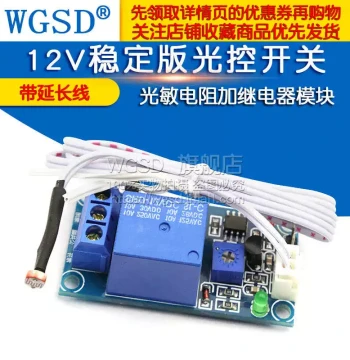
| Detection Component | GL5528 Photoresistor |
| PCB Dimensions | 32mm x 14mm |
| Mounting Hole Diameter | 3mm |
| Response Time | < 50ms |
| Spectral Peak | 540nm |
| Compatibility | Arduino, Raspberry Pi, Micro:bit |
| Package Weight | 2g |
Anonymous
Mar 27, 2026
Rating: 5/5
Easy to calibrate
The onboard potentiometer allows for easy adjustment of sensitivity. I used it to trigger an LED when the room got dark, and it worked on the first try.
Anonymous
Mar 26, 2026
Rating: 4/5
Solid performance
Does exactly what it says on the tin. The voltage output scales linearly with light intensity in my tests. Great for prototyping ambient light detection systems.
Anonymous
Mar 24, 2026
Rating: 5/5
Perfect for my smart lamp project
This sensor module works flawlessly with my Arduino Uno. The analog output is stable and responds quickly to changes in room lighting. The PH2.0 connector made wiring very clean.
Anonymous
Mar 15, 2026
Rating: 4/5
Good value for money
Great little sensor for learning electronics. It detected light levels accurately enough for my school project. Only wish the cables were a bit longer, but that's a minor issue.
Anonymous
Mar 10, 2026
Rating: 5/5
Great for plant monitoring
I integrated this into my automated plant watering system to monitor sunlight exposure. It has been running outdoors (in a protective case) for weeks without issues.
Anonymous
Mar 03, 2026
Rating: 5/5
Reliable and compact
We bought ten of these for our workshop kits. They are robust, easy to integrate, and the sensitivity is consistent across all units. Highly recommended for educational use.
Q: Does the package include connecting wires?
A: The module usually comes without wires. You will need to purchase PH2.0 jumper wires separately or solder your own connections.
Q: How do I adjust the sensitivity of the light detection?
A: There is a blue potentiometer on the back of the PCB. Turn it clockwise to increase sensitivity or counter-clockwise to decrease it while monitoring the output value.
Q: Is the output digital or analog?
A: This specific model provides an Analog Output (AO). If you need a digital signal, you would need to read the analog value and set a threshold in your code or use a comparator circuit.
Q: Can this module be used directly with a 3.3V microcontroller?
A: Yes, the operating voltage range is 3.3V to 5V, so it is fully compatible with 3.3V boards like the ESP32 or Raspberry Pi Pico.
Q: What is the maximum current consumption of this sensor?
A: The module typically consumes less than 10mA during operation, making it suitable for battery-powered projects.