Anonymous
Mar 31, 2026
Rating: 5/5
Great value for money
For the price, you cannot beat this sensor. It provides raw data clearly, allowing me to write my own filtering algorithms. Shipping was fast too.
Description
Reviews
| Brand | - |
| Category | Robotics / STEM Teaching Tools / Sensors |
| Origin | - |
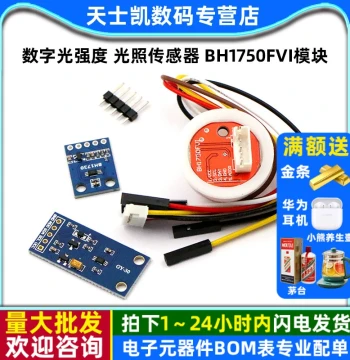
| Chip Model | MAX30102 |
| Interface Type | I2C |
| Operating Voltage | 1.8V - 3.3V |
| LED Wavelengths | Red (660nm) and IR (880nm) |
| FIFO Depth | 18 samples |
| Package Type | Breakout Board with Header Pins |
| Dimensions | 16mm x 9mm x 2mm |
| Compatibility | Arduino, Raspberry Pi, ESP32 |
| Sampling Rate | Up to 3200Hz |
| Application | Wearable Health Monitoring Prototyping |
Anonymous
Mar 31, 2026
Rating: 5/5
Great value for money
For the price, you cannot beat this sensor. It provides raw data clearly, allowing me to write my own filtering algorithms. Shipping was fast too.
Anonymous
Mar 31, 2026
Rating: 4/5
Good sensor, needs calibration
The hardware quality is solid. However, getting accurate SpO2 readings requires careful calibration and specific finger placement. Not a medical device, but great for data logging experiments.
Anonymous
Mar 25, 2026
Rating: 3/5
Sensitive to ambient light
Works well indoors, but struggles with accuracy if there is strong sunlight nearby. You definitely need to build a light-blocking enclosure for consistent results.
Anonymous
Mar 22, 2026
Rating: 4/5
Solid component for R&D
We used these for a university project on heart rate variability. The signal-to-noise ratio is decent for a breakout board. Just remember it's for prototyping, not clinical use.
Anonymous
Mar 18, 2026
Rating: 5/5
Perfect for wearable prototypes
This module works flawlessly with my ESP32 project. The I2C communication is stable, and the library support is excellent. Great for learning how pulse oximetry works.
Anonymous
Mar 14, 2026
Rating: 5/5
Easy to integrate
Connected easily to my Arduino Uno. The example codes provided in the community forums helped me get up and running in under an hour. Highly recommended for students.
Q: Is this module compatible with 5V Arduino boards?
A: Yes, but since the MAX30102 operates at 1.8V-3.3V, you should use a logic level converter or an Arduino board with 3.3V logic to avoid damaging the sensor.
Q: What is the maximum distance for detection?
A: This is a reflectance sensor, meaning the object (like a finger) must be in direct contact or very close (within a few millimeters) to the sensor surface.
Q: Does this come with a library for Python?
A: While we do not bundle a physical library, there are several open-source Python libraries available for Raspberry Pi that support the MAX30102 via I2C.
Q: Can this measure blood pressure?
A: No, this sensor is designed to detect heart rate and blood oxygen saturation (SpO2) levels only. It cannot measure blood pressure directly.
Q: Is the PCB waterproof?
A: No, the breakout board itself is not waterproof. If you plan to use it in a wearable device, you will need to add your own waterproofing enclosure.