Anonymous
Mar 29, 2026
Rating: 5/5
Standard component, high quality
This is the go-to light sensor for IoT prototypes. The original chip ensures better consistency than generic clones. No issues with noise or erratic data spikes.
Description
Reviews
| Brand | - |
| Category | Robotics / STEM Teaching Tools / Sensors |
| Origin | - |
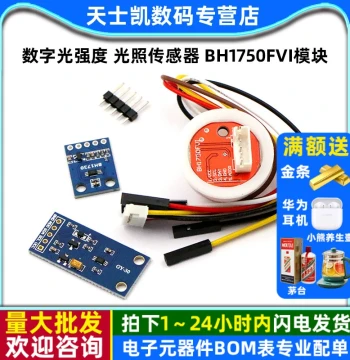
| Chip Model | Original BH1750FVI |
| Interface Type | I2C (Inter-Integrated Circuit) |
| Voltage Supply | 3.0V to 5.0V DC |
| Measurement Range | 1 to 65,535 Lux |
| Resolution | 1 Lux minimum |
| Spectral Response | Close to human eye sensitivity |
| Conversion Time | Approx. 120ms typical |
| Pin Count | 4 Pins (VCC, GND, SCL, SDA) |
| Board Dimensions | 22mm x 18mm x 3mm |
| Operating Temperature | -40°C to +85°C |
Anonymous
Mar 29, 2026
Rating: 5/5
Standard component, high quality
This is the go-to light sensor for IoT prototypes. The original chip ensures better consistency than generic clones. No issues with noise or erratic data spikes.
Anonymous
Mar 26, 2026
Rating: 5/5
Reliable for student projects
Bought ten of these for our university robotics club. All units performed consistently. The wide lux range is helpful for both indoor and outdoor testing scenarios.
Anonymous
Mar 18, 2026
Rating: 4/5
Works well but needs calibration
Using this to monitor sunlight for my greenhouse system. It works great, but I had to do some software calibration to match specific plant requirements. Hardware quality is solid.
Anonymous
Mar 17, 2026
Rating: 5/5
Perfect for Arduino projects
This sensor works flawlessly with my Arduino Uno. The library support is excellent, and the readings are very stable even in changing light conditions. Highly recommended for beginners.
Anonymous
Mar 15, 2026
Rating: 4/5
Good accuracy, easy wiring
Used this to automate my living room lights. The I2C interface makes wiring simple since it only needs two data lines. Accuracy seems good compared to my phone's sensor, though it takes a moment to stabilize.
Anonymous
Mar 13, 2026
Rating: 5/5
Great value for money
Arrived quickly and was well packaged. The chip looks authentic, and the soldering points on the breakout board are clean. Got it working in under 10 minutes following online tutorials.
Q: What is the maximum distance for the I2C connection?
A: For standard I2C communication without signal boosters, we recommend keeping the wire length under 30cm (approx. 1 foot) to ensure data integrity. For longer distances, you may need an I2C extender or buffer.
Q: Is this module compatible with Raspberry Pi?
A: Yes, this module is fully compatible with Raspberry Pi models that support I2C. You will need to enable the I2C interface in the Raspberry Pi configuration settings and connect the SDA and SCL pins to the appropriate GPIO headers.
Q: What happens if I connect 5V to the VCC pin?
A: The module is designed to operate between 3.0V and 5.0V, so connecting 5V to the VCC pin is safe and within the specified operating range. Many users power it directly from the 5V pin on Arduino boards.
Q: Can this sensor measure UV index?
A: No, the BH1750FVI measures illuminance in Lux, which corresponds to visible light perceived by the human eye. It does not specifically measure Ultraviolet (UV) radiation. For UV monitoring, a dedicated UV sensor is required.
Q: Does this come with a library for ESP32?
A: While the module itself does not include physical media, it is widely supported by the Arduino IDE library manager. You can search for 'BH1750' in the library manager, which provides examples compatible with ESP32, Arduino, and other microcontrollers.