Anonymous
Mar 16, 2026
Rating: 3/5
Works but documentation could be better
The hardware itself seems fine, but I struggled a bit finding clear examples for the specific register settings. Once I found a good GitHub repo, it worked great.
Description
Reviews
| Brand | - |
| Category | Robotics / STEM Teaching Tools / Sensors |
| Origin | - |
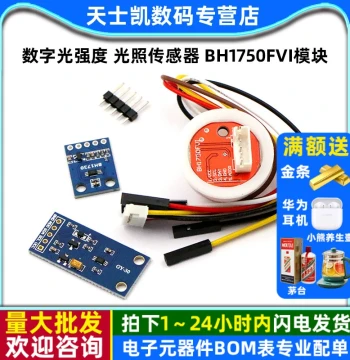
| Model Number | MAX30102 / KY-039 Compatible |
| Interface Type | I2C (Inter-Integrated Circuit) |
| Operating Voltage | 3.3V - 5.0V DC |
| Wavelengths | Red (660nm) and Infrared (880nm) |
| FIFO Buffer | 18-bit Data Storage |
| Sample Rate | Adjustable up to 3200Hz |
| LED Current | Programmable up to 50mA |
| Package Type | Breakout Board with Header Pins |
| Compatibility | Arduino, Raspberry Pi, ESP32, STM32 |
| Primary Application | Wearable Heart Rate & SpO2 Monitoring |
Anonymous
Mar 16, 2026
Rating: 3/5
Works but documentation could be better
The hardware itself seems fine, but I struggled a bit finding clear examples for the specific register settings. Once I found a good GitHub repo, it worked great.
Anonymous
Mar 15, 2026
Rating: 5/5
Excellent replacement part
Bought this to replace a faulty sensor in an old fitness tracker prototype. The pinout matches perfectly, and the signal quality is actually better than the original component.
Anonymous
Mar 08, 2026
Rating: 4/5
Great raw data output
If you are looking to analyze PPG signals, this gives you clean raw data. The FIFO buffer helps prevent data loss during high-speed sampling. Highly recommended for data logging projects.
Anonymous
Mar 06, 2026
Rating: 5/5
Perfect for DIY Wearables
This module works flawlessly with my Arduino project. The I2C communication is stable, and the library support is excellent. I was able to get heart rate readings within minutes of setup.
Anonymous
Mar 04, 2026
Rating: 4/5
Good value, needs calibration
The sensor is sensitive and picks up pulses well. However, you need to calibrate it properly for accurate SpO2 readings. Great for learning and prototyping, but don't rely on it for medical diagnosis.
Anonymous
Mar 04, 2026
Rating: 5/5
Compact and Efficient
Love how small this breakout board is. It fits perfectly into my custom wristband design. Power consumption is low, which is crucial for battery-operated projects.
Q: What is the difference between MAX30100 and MAX30102 used here?
A: The MAX30102 offers improved performance over the MAX30100, including better motion artifact rejection, lower power consumption, and a more robust I2C interface.
Q: Is 5V logic safe for this module?
A: The module typically includes voltage regulation, but the I2C lines are 3.3V tolerant. If your microcontroller uses 5V logic, we recommend using a logic level converter to ensure safety.
Q: Does this module come with a library for Arduino?
A: Yes, there are several open-source libraries available on GitHub and the Arduino Library Manager that support the MAX30102 chip, making integration very easy.
Q: How do I clean the sensor surface if it gets dirty?
A: Gently wipe the LED and photodetector glass with a soft, lint-free cloth slightly dampened with isopropyl alcohol. Avoid scratching the surface as it affects light transmission.
Q: Can this measure blood oxygen accurately without a finger clip?
A: While the sensor can detect SpO2 levels from the wrist or finger, accuracy varies based on skin tone, movement, and fit. It is designed for educational and prototyping purposes, not clinical use.