Anonymous
Mar 27, 2026
Rating: 5/5
Perfect for Arduino Projects
This module works flawlessly with my Arduino Uno. The breakout board makes wiring incredibly easy, and the readings are stable after calibration. Great value for the price.
Description
Reviews
| Brand | - |
| Category | Robotics / STEM Teaching Tools / Sensors |
| Origin | - |
| Model Number | ACS712ELCTR |
| Current Range Options | 5A, 20A, 30A |
| Operating Voltage | 5V DC |
| Output Sensitivity (5A) | 185 mV/A |
| Output Sensitivity (20A) | 100 mV/A |
| Output Sensitivity (30A) | 66 mV/A |
| Bandwidth | 80 kHz |
| Isolation Voltage | 2.1 kV RMS |
| Response Time | 5 µs |
| Package Type | SOIC-8 with Breakout Board |
Anonymous
Mar 27, 2026
Rating: 5/5
Perfect for Arduino Projects
This module works flawlessly with my Arduino Uno. The breakout board makes wiring incredibly easy, and the readings are stable after calibration. Great value for the price.
Anonymous
Mar 24, 2026
Rating: 4/5
Good accuracy for the cost
I am using the 20A version to monitor my solar panel output. It is not lab-grade precision, but for DIY energy monitoring, it is more than sufficient. Just remember to calibrate it against a multimeter.
Anonymous
Mar 22, 2026
Rating: 5/5
Great for learning electronics
Bought this for my university final year project. The documentation online is plentiful, and the sensor responded exactly as expected in our tests. Highly recommend for students.
Anonymous
Mar 20, 2026
Rating: 5/5
Compact and Reliable
Used this in a custom battery management system for a robot. The isolation feature gives me peace of mind when dealing with higher currents. No noise issues so far.
Anonymous
Mar 19, 2026
Rating: 5/5
Bulk buy success
Purchased ten of these for our makerspace workshop. All units were functional out of the box. The consistent quality makes them ideal for teaching classes on current measurement.
Anonymous
Mar 07, 2026
Rating: 4/5
Works well but gets warm
The sensor functions correctly, but I noticed it gets slightly warm when running near the 20A limit for extended periods. Ensure you have some airflow if pushing the limits.
Q: Can this module measure AC current as well as DC?
A: Yes, the ACS712 sensor is capable of measuring both AC and DC current. The output voltage will vary around the VCC/2 baseline depending on the direction and type of current.
Q: How do I calibrate the sensor for accurate readings?
A: First, read the output with no current flowing to find the zero-point (usually around 2.5V). Then, pass a known current through the sensor and adjust your code's sensitivity factor until the calculated value matches the known current.
Q: What is the exact pinout for connecting this to an ESP32?
A: Connect the VCC pin to 5V (or 3.3V depending on your specific board tolerance, though 5V is recommended for stability), GND to GND, and the OUT pin to any analog GPIO pin on the ESP32.
Q: Does this come with screw terminals for high current wires?
A: No, this breakout board uses standard header pins. For high current applications, we recommend soldering thick gauge wires directly to the heavy-duty copper traces on the bottom or adding your own terminal blocks.
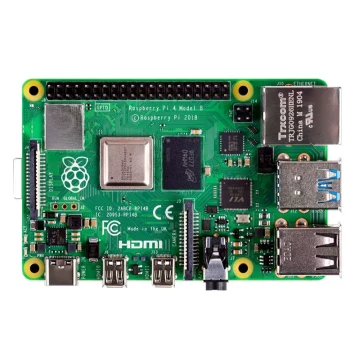
Q: Is there a library available for Raspberry Pi?
A: Since the output is analog, you cannot connect it directly to a Raspberry Pi GPIO which is digital only. You will need an external ADC (like MCP3008) and then use Python libraries like spidev to read the data.