Anonymous
Mar 29, 2026
Rating: 4/5
Good board, check your voltage requirements
Works great, just ensure your external power supply matches the input requirements if not powering via USB. The onboard regulator handles 5V input well.
Description
Reviews
| Brand | - |
| Category | Robotics / STEM Teaching Tools / Development, Learning, Evaluation & Industrial Control Boards |
| Origin | - |
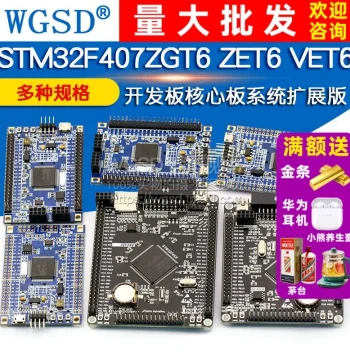
| Microcontroller Model | STM32F407ZGT6 |
| Architecture | ARM Cortex-M4 32-bit RISC |
| Maximum Frequency | 168 MHz |
| Flash Memory | 1 MB |
| SRAM | 192 KB + 4 KB Backup |
| I/O Pins | 114 Fast I/Os |
| Communication Interfaces | 3x SPI, 3x I2C, 4x USART, 2x CAN, USB OTG |
| ADC Resolution | 12-bit, up to 24 channels |
| Operating Voltage | 3.3V (Logic), 5V (Input via regulator) |
| Package Type | LQFP144 |
Anonymous
Mar 29, 2026
Rating: 4/5
Good board, check your voltage requirements
Works great, just ensure your external power supply matches the input requirements if not powering via USB. The onboard regulator handles 5V input well.
Anonymous
Mar 24, 2026
Rating: 4/5
Solid performance, minor soldering needed
The core board itself is high quality. Note that you may need to solder headers depending on your carrier board setup. Once set up, the 168MHz speed is noticeable.
Anonymous
Mar 19, 2026
Rating: 5/5
Excellent learning tool
Bought this for my university embedded systems course. It handles complex RTOS tasks without breaking a sweat. Documentation online is plentiful for this specific chip.
Anonymous
Mar 13, 2026
Rating: 5/5
Great value for money
Compared to other development boards with similar specs, this offers incredible value. Flashing firmware via SWD is fast and reliable.
Anonymous
Mar 04, 2026
Rating: 5/5
Perfect for embedded projects
This board works exactly as described. The pinout is standard, and it integrates seamlessly with my existing STM32 debugger. Great for prototyping industrial control systems.
Anonymous
Mar 04, 2026
Rating: 5/5
Reliable for production prototypes
We used these for our initial prototype batch. Stability is excellent, and the peripheral support (CAN, Ethernet MAC) saved us a lot of design time.
Q: Does it have built-in USB-to-Serial conversion?
A: This core board features a USB OTG FS/HS controller, but it does not include a built-in USB-to-UART bridge chip. You would need an external FTDI or CP210x module for serial console output if not using the native USB peripheral.
Q: Does this board come with pre-soldered pin headers?
A: No, this is a core board intended to be mounted on a carrier board or breadboard. Pin headers are not included to allow for flexible mounting options.
Q: What debugger interface does this support?
A: This board supports SWD (Serial Wire Debug) and JTAG interfaces. We recommend using an ST-Link V2 or V3 debugger for the best experience.
Q: Can I drive 5V peripherals directly from the GPIO pins?
A: No, the GPIO logic level is 3.3V. Driving 5V peripherals directly may damage the microcontroller. Please use a logic level shifter or ensure your peripherals are 3.3V tolerant.
Q: Is this compatible with the Arduino IDE?
A: Yes, you can use the Arduino IDE by installing the appropriate STM32 board support package (via Board Manager). You will need an ST-Link programmer to upload code.