Anonymous
Mar 21, 2026
Rating: 5/5
Ideal for prototyping
The layout allows for easy access to all pins via headers. I was able to prototype a motor control system in just two days. Highly recommended for engineers and students alike.
Description
Reviews
| Brand | - |
| Category | Robotics / STEM Teaching Tools / Development, Learning, Evaluation & Industrial Control Boards |
| Origin | - |
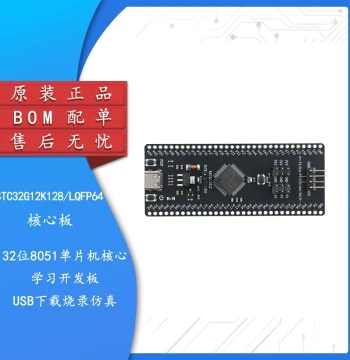
| Microcontroller Model | STM32F103VET6 |
| Architecture | ARM Cortex-M3 32-bit RISC |
| Flash Memory | 512 KB |
| SRAM | 64 KB |
| Max Frequency | 72 MHz |
| I/O Ports | 80 GPIO pins |
| Debug Interface | JTAG/SWD supported |
| Power Supply | USB or External 5V/3.3V |
| Onboard Peripherals | LEDs, Buttons, Buzzer, RTC |
| Expansion Interfaces | UART, SPI, I2C, CAN, USB, Ethernet |
Anonymous
Mar 21, 2026
Rating: 5/5
Ideal for prototyping
The layout allows for easy access to all pins via headers. I was able to prototype a motor control system in just two days. Highly recommended for engineers and students alike.
Anonymous
Mar 14, 2026
Rating: 4/5
Good community support
Had a minor issue configuring the PLL, but the Wildfire forum and existing GitHub repositories helped me solve it quickly. The board itself performs very well.
Anonymous
Mar 12, 2026
Rating: 5/5
Excellent value for money
Compared to other evaluation boards on the market, this offers incredible features for the price. The onboard debugger interface works flawlessly with my ST-Link V2.
Anonymous
Mar 11, 2026
Rating: 5/5
Perfect for learning embedded systems
This board is exactly what I needed to get started with STM32 development. The documentation provided by Wildfire is comprehensive, and the pinout is clearly labeled on the silkscreen.
Anonymous
Mar 09, 2026
Rating: 5/5
Robust and reliable
I've been using this board for a university project involving sensor data logging. It has run continuously for weeks without any issues. The power management is very stable.
Anonymous
Mar 01, 2026
Rating: 4/5
Great hardware, steep learning curve
The build quality is excellent and all peripherals work out of the box. However, beginners should be prepared to spend time understanding the register-level programming if not using an IDE like Keil or STM32CubeIDE.
Q: What is the maximum current output for the 3.3V pin?
A: The onboard LDO regulator can typically supply up to 200mA for the 3.3V rail. For high-power peripherals, we recommend using an external power source connected to the VIN pin.
Q: Is the board compatible with the Arduino IDE?
A: Yes, the STM32F103VET6 is compatible with the Arduino IDE using the STM32duino core. You may need to install the appropriate board package via the Board Manager.
Q: Can I power this board directly via USB-C?
A: This board version uses a standard Micro-USB port for power and communication. It does not feature USB-C. Please ensure you use a standard Micro-USB cable rated for data transfer.
Q: Are example codes available for the onboard sensors and peripherals?
A: Yes, Wildfire provides a complete software package including demo projects for UART, SPI, I2C, ADC, Timers, and the onboard buzzer and LEDs. These can be downloaded from our official resource page.
Q: Does this board come with a built-in programmer or do I need an external ST-Link?
A: This specific model does not have a built-in programmer. You will need an external ST-Link V2 or J-Link debugger to flash code and debug via the SWD or JTAG headers provided on the board.