Anonymous
Mar 28, 2026
Rating: 5/5
Excellent STM32 implementation
Love that it uses the standard STM32 chip so I can program it directly with STM32CubeIDE if I don't want to use the pre-loaded firmware. Very flexible for custom projects.
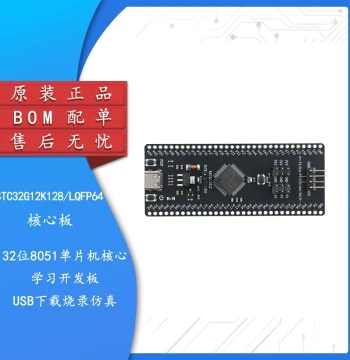
Description
Reviews
| Brand | - |
| Category | Robotics / STEM Teaching Tools / Development, Learning, Evaluation & Industrial Control Boards |
| Origin | - |
| Microcontroller | STM32F103C8T6 ARM Cortex-M3 |
| Motor Channels | 4-channel Encoder Motor Control |
| Servo Interfaces | 8-channel PWM Servo Driver |
| Communication Protocols | UART, I2C, SPI, CAN Bus |
| ROS Compatibility | Supports ROS 1 and ROS 2 via Serial/USB |
| Input Voltage | 7V - 24V DC (with reverse polarity protection) |
| Debug Interface | SWD/JTAG Standard 20-pin Header |
| Encoder Support | Quadrature Encoder Input up to 10kHz |
| Board Dimensions | 85mm x 55mm x 15mm |
| Operating Temperature | -20°C to +70°C |
Anonymous
Mar 28, 2026
Rating: 5/5
Excellent STM32 implementation
Love that it uses the standard STM32 chip so I can program it directly with STM32CubeIDE if I don't want to use the pre-loaded firmware. Very flexible for custom projects.
Anonymous
Mar 23, 2026
Rating: 5/5
Best board for the price
Compared to other motor drivers, this offers way more features for the cost. The ability to control both encoders and servos on one board saves so much space in my robot chassis.
Anonymous
Mar 14, 2026
Rating: 5/5
Industrial grade performance
I've used this in a prototype for a warehouse AGV. The CAN bus implementation is stable, and the servo control is precise. It survived several voltage spikes during testing without issue.
Anonymous
Mar 09, 2026
Rating: 5/5
Perfect for my differential drive robot
This board made integrating encoder feedback incredibly easy. The ROS nodes provided in the documentation worked out of the box with my Ubuntu setup. Highly recommended for anyone building autonomous mobile robots.
Anonymous
Mar 09, 2026
Rating: 4/5
Solid controller for research bots
We are using five of these for our university lab. They communicate reliably over USB-serial. One board had a loose header pin, but support sent a replacement immediately.
Anonymous
Mar 04, 2026
Rating: 4/5
Great value but docs could be better
Hardware is solid and handles my NEMA motors without heating up. The pinout diagram was a bit confusing at first, but once I mapped it out, everything worked perfectly. Good learning tool.
Q: What is the maximum current per motor channel?
A: Each motor channel can handle up to 2A continuous current with a peak of 3A. For higher current motors, we recommend using external MOSFET drivers controlled by this board's PWM outputs.
Q: Does it work with Raspberry Pi 4?
A: Absolutely. It connects easily to a Raspberry Pi 4 via USB-to-TTL or direct UART GPIO pins. Many users run the ROS master on the Pi and use this board as the microcontroller node.
Q: Does this board support Python scripting directly on the MCU?
A: The board comes with C++ firmware optimized for ROS. However, since it uses an STM32 chip, you can flash MicroPython or Pyboard firmware if you wish to program in Python, though you may need to rewrite the motor driver libraries.
Q: Can I power the servos and the logic board from the same input?
A: Yes, the board features separate voltage regulation. You can feed 12V into the main input, and it will step down to 5V/3.3V for the logic while passing the appropriate voltage to the servo rail, adjustable via jumper.
Q: Is there a sample ROS package available for download?
A: Yes, please visit our GitHub repository linked in the user manual. We provide a full ROS workspace with launch files, node source code, and example URDF models for common robot configurations.