Anonymous
Mar 28, 2026
Rating: 5/5
Reliable minimum system board
I've purchased five of these for a university project. All boards passed initial testing immediately. The voltage regulator is stable, and the reset circuit works as expected.
Description
Reviews
| Brand | - |
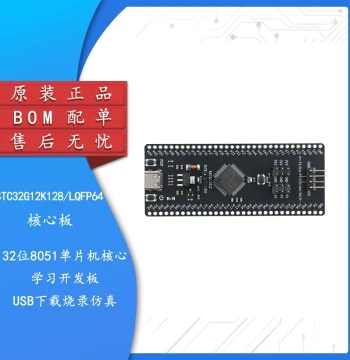
| Category | Robotics / STEM Teaching Tools / Development, Learning, Evaluation & Industrial Control Boards |
| Origin | - |
| Microcontroller Model | STM32F103C8T6 |
| Architecture | ARM Cortex-M3 32-bit RISC |
| Operating Frequency | Up to 72 MHz |
| Flash Memory | 64 KB |
| SRAM | 20 KB |
| Operating Voltage | 3.3V (Logic), 5V Input via Regulator |
| GPIO Pins | 37 Programmable I/O Lines |
| Debug Interface | SWD and JTAG |
| Board Dimensions | 53mm x 23mm |
| Package Type | LQFP48 |
Anonymous
Mar 28, 2026
Rating: 5/5
Reliable minimum system board
I've purchased five of these for a university project. All boards passed initial testing immediately. The voltage regulator is stable, and the reset circuit works as expected.
Anonymous
Mar 19, 2026
Rating: 5/5
Excellent compatibility with CubeIDE
No driver issues on Windows 10. Recognized instantly by STM32CubeIDE. The documentation provided by the seller helped me get my first LED blinking in minutes.
Anonymous
Mar 18, 2026
Rating: 4/5
Great for embedded control projects
Using this for a small motor controller project. The PWM outputs are clean, and the ADC resolution is sufficient for my sensors. Wish it had a built-in USB-to-UART bridge, but that's standard for this form factor.
Anonymous
Mar 06, 2026
Rating: 5/5
Perfect for learning ARM architecture
This board is exactly what I needed to transition from Arduino to STM32. The pinout is clearly labeled, and it works flawlessly with the ST-Link debugger. Great value for the price.
Anonymous
Mar 02, 2026
Rating: 5/5
Best budget Cortex-M3 board
Compared to other options in this price range, the build quality is superior. The PCB traces look clean, and the component placement allows easy access to all pins for probing.
Anonymous
Mar 02, 2026
Rating: 4/5
Good quality, minor soldering needed
The chip itself is genuine and runs at 72MHz without issues. Note that the header pins were not pre-soldered on my unit, so be prepared to do some basic soldering before use.
Q: Does this board come with pre-soldered header pins?
A: Typically, these boards are shipped without pre-soldered headers to allow flexibility for breadboard or custom PCB usage. You will need to solder them yourself.
Q: Is this compatible with the Arduino IDE?
A: Yes, you can program this board using the Arduino IDE by installing the appropriate STM32 core packages (such as STM32duino). However, native support is best achieved with STM32CubeIDE or Keil.
Q: What debugger do I need to program this chip?
A: You will need an ST-Link V2 or V3 debugger/programmer. Connect it to the SWDIO, SWCLK, GND, and 3.3V pins on the board to flash your code.
Q: Can I power this board directly via USB?
A: No, this specific minimum system board does not have an onboard USB connector. You must provide 3.3V or 5V power through the designated VIN or 3.3V pins using an external programmer or power supply.
Q: What is the maximum current this board can source per GPIO pin?
A: According to the STM32F103C8T6 datasheet, each I/O port can sink or source up to 25mA, with a total limit for the port and the entire device. Please refer to the official datasheet for detailed electrical characteristics.