Anonymous
Mar 19, 2026
Rating: 5/5
Reliable and compact
Small form factor makes it easy to integrate into final prototypes. I've burned two of these so far testing high-current loads (my fault), but they are cheap enough to replace easily.
Description
Reviews
| Brand | - |
| Category | Robotics / STEM Teaching Tools / Development, Learning, Evaluation & Industrial Control Boards |
| Origin | - |
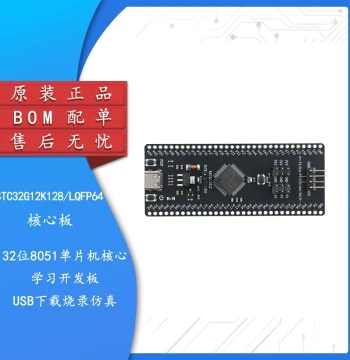
| Microcontroller Model | STM32F103C8T6 |
| Core Architecture | ARM Cortex-M3 32-bit RISC |
| Maximum Frequency | 72 MHz |
| Flash Memory | 64 KB |
| SRAM | 20 KB |
| Operating Voltage | 3.3V (Input: 5V via USB or VIN) |
| Digital I/O Pins | 37 GPIO pins |
| Communication Interfaces | 3x USART, 2x SPI, 2x I2C, CAN, USB 2.0 |
| Debug Interface | SWD (Serial Wire Debug) and JTAG |
| Board Dimensions | 53mm x 23mm x 10mm |
Anonymous
Mar 19, 2026
Rating: 5/5
Reliable and compact
Small form factor makes it easy to integrate into final prototypes. I've burned two of these so far testing high-current loads (my fault), but they are cheap enough to replace easily.
Anonymous
Mar 17, 2026
Rating: 5/5
Perfect for learning ARM architecture
This board is exactly what I needed to transition from Arduino to STM32. The pinout is clearly labeled, and it works flawlessly with the STM32CubeIDE. Great value for the price.
Anonymous
Mar 14, 2026
Rating: 5/5
Best budget development board
As a university student, this fits my budget perfectly. It supports MicroPython and C/C++. The community support is huge, making troubleshooting very easy.
Anonymous
Mar 12, 2026
Rating: 4/5
Good performance, lacks onboard debugger
The chip itself is powerful. However, remember that you need a separate ST-Link programmer to upload code, as there is no onboard USB-to-serial converter for programming on this specific minimal version.
Anonymous
Mar 04, 2026
Rating: 4/5
Solid board, minor soldering needed
The hardware is reliable and runs at 72MHz without issues. Note that the header pins sometimes come unsoldered, so be prepared to add them yourself if your kit doesn't include pre-soldered ones.
Anonymous
Mar 01, 2026
Rating: 5/5
Great for motor control projects
I used this for a drone flight controller prototype. The PWM outputs are precise, and the ADC resolution is sufficient for sensor reading. Highly recommended for industrial control learning.
Q: What debugger do I need to program this board?
A: To program and debug this board, you typically need an ST-Link V2 or V3 programmer. You connect it to the SWDIO, SWCLK, GND, and 3.3V pins located on the dedicated debug header.
Q: Does this board come with pre-soldered header pins?
A: It depends on the specific listing option you choose. Some versions come with headers pre-soldered, while others ship with loose pins for you to solder based on your project needs. Please check the product variation details before ordering.
Q: Is this compatible with the Arduino IDE?
A: Yes, this board is compatible with the Arduino IDE. You will need to install the STM32 board package by STMicroelectronics via the Board Manager and select the appropriate generic STM32F103C8 series board.
Q: What is the maximum current this board can supply on the 3.3V pin?
A: The onboard LDO regulator can typically supply up to 200mA-300mA total for the board and external peripherals. For high-power devices, we recommend using an external power source rather than drawing from the board's 3.3V pin.
Q: Can I power this board directly via the micro USB port?
A: Yes, you can power the board via the micro USB port which provides 5V. The onboard regulator converts this to 3.3V for the microcontroller. Alternatively, you can supply 3.3V directly to the 3.3V pin if you have an external regulated source.