Anonymous
Mar 29, 2026
Rating: 5/5
Fast and Reliable
Upgraded from the ESP32-C3 and the speed improvement is noticeable. The extra flash memory allows for more complex firmware updates over the air.
Description
Reviews
| Brand | - |
| Category | Robotics / STEM Teaching Tools / Development, Learning, Evaluation & Industrial Control Boards |
| Origin | - |
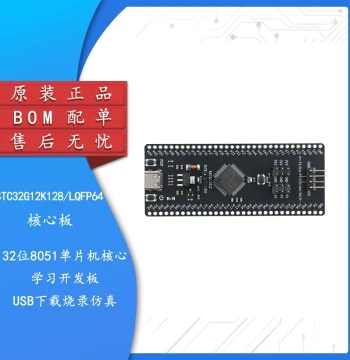
| Microcontroller | ESP32-S3-WROOM-1-N16R8 |
| CPU Architecture | Dual-core 32-bit Xtensa LX7 |
| Flash Memory | 16 MB |
| PSRAM | 8 MB Octal SPI |
| Wireless Connectivity | Wi-Fi 2.4 GHz (802.11 b/g/n) and Bluetooth 5 (LE) |
| Operating Voltage | 3.3V |
| Input Voltage | 5V via USB or VIN pin |
| GPIO Pins | 45 programmable GPIOs |
| AI Acceleration | Vector instructions for neural network processing |
| Interface | USB-to-UART bridge with native USB support |
Anonymous
Mar 29, 2026
Rating: 5/5
Fast and Reliable
Upgraded from the ESP32-C3 and the speed improvement is noticeable. The extra flash memory allows for more complex firmware updates over the air.
Anonymous
Mar 23, 2026
Rating: 5/5
Excellent for classroom use
We bought ten of these for our robotics workshop. Students love the dual-core capability, and the built-in antenna works well without needing external components.
Anonymous
Mar 13, 2026
Rating: 5/5
Best S3 board I've tested
The power management is efficient, and the thermal performance remains cool even under continuous Wi-Fi transmission loads. Highly recommended for sensor hubs.
Anonymous
Mar 07, 2026
Rating: 4/5
Great board, minor documentation gaps
Hardware is solid and performance is excellent for the price. I wish the pinout diagram in the manual was slightly clearer regarding the native USB pins, but online resources filled the gap quickly.
Anonymous
Mar 06, 2026
Rating: 4/5
Good value but steep learning curve
As a beginner, I found the advanced features a bit overwhelming at first. However, once I got the basic blink example working, the potential for this board became clear.
Anonymous
Mar 04, 2026
Rating: 5/5
Perfect for AIoT Projects
The 8MB PSRAM makes a huge difference when running TinyML models. Setup was straightforward using the Arduino IDE, and the Wi-Fi connection is very stable.
Q: Does this include an external antenna connector?
A: No, this specific DevKit model uses an onboard PCB antenna. If you require an external antenna connector (IPEX/U.FL), please look for the variant labeled with an external antenna option.
Q: Can I power this directly from a 3.7V LiPo battery?
A: Yes, you can connect a LiPo battery to the 5V pin if your battery has a protection circuit, or use the BAT pin if your specific variant exposes it. Please check the schematic for your specific revision to ensure safe voltage levels.
Q: What is the maximum current draw for the GPIO pins?
A: Each GPIO pin can source or sink up to 40mA. However, the total current drawn from all GPIOs combined should not exceed the limits specified in the ESP32-S3 datasheet to avoid damaging the chip.
Q: Does this board support MicroPython out of the box?
A: The board comes with no pre-flashed firmware, but it is fully compatible with MicroPython. You can easily flash the latest MicroPython binary using esptool.py.
Q: Is the USB port suitable for high-speed data transfer?
A: The native USB port supports Full-Speed (12 Mbps) device mode. It is ideal for CDC/UART communication and HID devices, but not intended for mass storage high-speed transfers.