Anonymous
Apr 13, 2026
Rating: 4/5
Good Signal Quality
Requires careful placement on the finger to get consistent readings. Once calibrated in the code, the heart rate data matches my gym equipment closely.
Description
Reviews
| Brand | - |
| Category | Electronic Components / Maker DIY / Computer Hardware, Monitors & Peripherals |
| Origin | - |
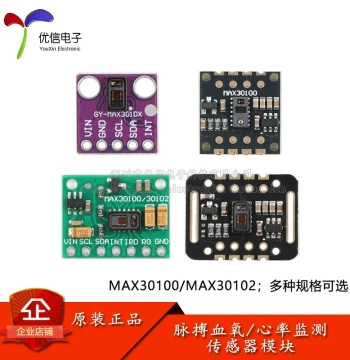
| Model Number | MAX30102 |
| Operating Voltage | 1.8V to 3.3V |
| Communication Interface | I2C (400kHz) |
| Red LED Wavelength | 660nm |
| IR LED Wavelength | 880nm |
| FIFO Buffer Depth | 18 Samples |
| Operating Temperature | -40°C to 85°C |
| PCB Dimensions | 22mm x 17mm |
| Compatible Platforms | Arduino, ESP32, STM32 |
| Regulatory Status | Not a Medical Device |
Anonymous
Apr 13, 2026
Rating: 4/5
Good Signal Quality
Requires careful placement on the finger to get consistent readings. Once calibrated in the code, the heart rate data matches my gym equipment closely.
Anonymous
Apr 01, 2026
Rating: 3/5
Learning Curve Exists
Not for beginners. You need to understand I2C and registers. Once set up, it works as described. Documentation could be more detailed.
Anonymous
Mar 30, 2026
Rating: 5/5
Low Power Draw
Perfect for battery projects. The shutdown mode saves energy. I am using this in a custom fitness tracker prototype and it performs well.
Anonymous
Feb 27, 2026
Rating: 5/5
Excellent for Prototyping
Works flawlessly with ESP32. The I2C communication is stable and the signal quality is good for a development module. Not for medical use but perfect for learning.
Anonymous
Feb 05, 2026
Rating: 5/5
Great Library Support
Found open source code easily on GitHub. Integration took less than an hour. Low power consumption makes it ideal for battery-powered wearables.
Q: Is the module water resistant?
A: No, the PCB and components are not waterproof. You must design a waterproof enclosure if using it in wet conditions.
Q: Is this sensor FDA approved for medical use?
A: No, this product is for engineering development and hobbyist use only. It is not certified for medical diagnosis or treatment.
Q: Can I connect this directly to a 5V Arduino?
A: The module operates at 3.3V. While some boards have regulators, we recommend using a logic level shifter for I2C lines to ensure safety.
Q: What is the maximum sampling rate?
A: The sampling rate is configurable via registers, up to 3200Hz depending on your resolution and power settings.
Q: Does this come with a wrist strap included?
A: This listing is for the sensor module board only. You will need to design or purchase a separate enclosure for wrist mounting.