Anonymous
Apr 13, 2026
Rating: 5/5
Perfect for DIY Scales
Worked straight out of the box with my Arduino Uno. Calibration was straightforward using the included weights.
Description
Reviews
| Brand | - |
| Category | Electronic Components / Maker DIY / Computer Hardware, Monitors & Peripherals |
| Origin | - |
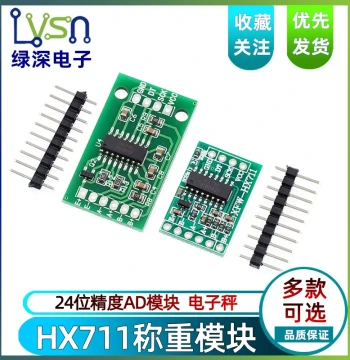
| Model Number | ZY-HX710B |
| Operating Voltage | 5V DC |
| ADC Resolution | 24-bit |
| Interface Type | Digital GPIO / UART |
| Sampling Rate | 10SPS or 80SPS |
| Input Channels | 2 Differential |
| Programmable Gain | 32, 64, 128 |
| PCB Dimensions | 35mm x 25mm x 10mm |
| Compatibility | Arduino, Raspberry Pi, STM32 |
| Package Weight | 150g |
Anonymous
Apr 13, 2026
Rating: 5/5
Perfect for DIY Scales
Worked straight out of the box with my Arduino Uno. Calibration was straightforward using the included weights.
Anonymous
Apr 11, 2026
Rating: 4/5
Solid Component
Requires some soldering knowledge for permanent projects but great for breadboarding and experiments.
Anonymous
Mar 27, 2026
Rating: 5/5
Accurate Readings
Very stable readings once calibrated. Great for learning about load cells and sensor integration.
Anonymous
Mar 17, 2026
Rating: 4/5
Good Value Kit
The module itself is excellent. The calibration weights are a bit light plastic but sufficient for testing.
Anonymous
Feb 21, 2026
Rating: 5/5
Fast Shipping
Arrived quickly and well packaged. No damage to the sensitive components during transit.
Q: What is the maximum weight this can measure?
A: It depends on the load cell used. This kit includes a small sensor rated for approximately 1kg.
Q: Is there a Python library available?
A: Yes, there are several open-source libraries available for Raspberry Pi and Arduino compatible with this module.
Q: Does the kit include a display screen?
A: No, this kit focuses on the sensor module. You will need to purchase a display separately if required.
Q: Can I connect a different load cell?
A: Yes, the module supports standard 4-wire or 6-wire load cells with appropriate wiring adjustments.
Q: Does this work with Raspberry Pi 4?
A: Yes, it connects via GPIO pins. Please refer to the wiring diagram in the manual for pinout details.