Anonymous
Mar 27, 2026
Rating: 5/5
Excellent documentation support
I was worried about the complexity, but the community examples made it easy to get raw data flowing. The breakout board layout is logical and easy to solder.
Description
Reviews
| Brand | - |
| Category | Robotics / STEM Teaching Tools / Sensors |
| Origin | - |
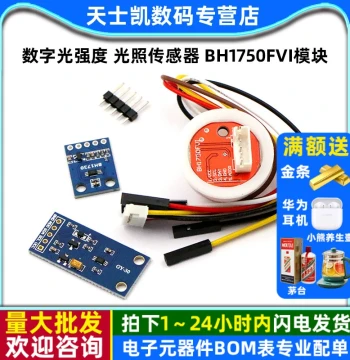
| Chip Model | MAX30102 |
| Interface | I2C |
| Operating Voltage | 1.8V / 3.3V |
| LED Wavelengths | Red (660nm) and IR (880nm) |
| FIFO Depth | 18 samples |
| Sample Rate Range | 50Hz to 3200Hz |
| Package Type | Breakout Board with Header Pins |
| Dimensions | 20mm x 16mm x 4mm |
| Compatibility | Arduino, Raspberry Pi, ESP32 |
| Application | Wearable Health Monitoring Prototyping |
Anonymous
Mar 27, 2026
Rating: 5/5
Excellent documentation support
I was worried about the complexity, but the community examples made it easy to get raw data flowing. The breakout board layout is logical and easy to solder.
Anonymous
Mar 26, 2026
Rating: 5/5
Fast shipping and great condition
Arrived quickly and was well-packaged. The pins were straight, and it connected immediately to my ESP32. Highly recommend for students and makers.
Anonymous
Mar 24, 2026
Rating: 5/5
Perfect for wearable prototypes
This module works flawlessly with my Arduino project. The I2C communication is stable, and the library support is excellent. Great for learning about biometric sensors.
Anonymous
Mar 18, 2026
Rating: 4/5
Solid component for the price
Does exactly what it says on the tin. The MAX30102 chip is a step up from older models. Just ensure you have a good 3.3V power supply for stable results.
Anonymous
Mar 08, 2026
Rating: 3/5
Works but sensitive to motion
As expected for optical sensors, motion artifacts are an issue if not mounted securely. It's a great development tool, just remember this is a sensor module, not a finished medical device.
Anonymous
Mar 06, 2026
Rating: 4/5
Good value but needs calibration
The hardware quality is solid for the price. You do need to spend some time calibrating the LED intensity to get consistent readings on different skin tones, but once set up, it works well.
Q: What libraries work best with this sensor?
A: For Arduino, the 'SparkFun MAX3010x Pulse and Proximity Sensor Library' is widely used. For Python/Raspberry Pi, there are several open-source options available on GitHub.
Q: Can this measure blood pressure?
A: No, this sensor measures heart rate and blood oxygen saturation (SpO2) using photoplethysmography. It cannot measure blood pressure directly.
Q: Does it come with a protective case?
A: No, this item is sold as a bare breakout module intended for integration into custom projects or prototyping boards. You will need to design your own enclosure.
Q: How far should the sensor be from the skin?
A: The sensor requires direct contact or very close proximity (within a few millimeters) to the skin to accurately detect light reflection from blood flow.
Q: Is this module compatible with 5V Arduino boards?
A: Yes, but please note the sensor operates at 1.8V-3.3V. Most breakout boards include a voltage regulator, but you should verify your specific board's schematic before connecting to 5V logic lines.