Anonymous
Mar 27, 2026
Rating: 5/5
Best bang for your buck
Compared to other development boards in this category, the feature set here is unmatched for the price. The 512KB flash allows for complex applications without memory constraints.
Description
Reviews
| Brand | - |
| Category | Robotics / STEM Teaching Tools / Development, Learning, Evaluation & Industrial Control Boards |
| Origin | - |
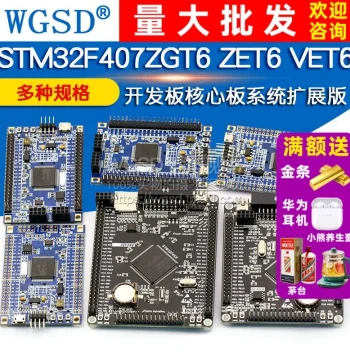
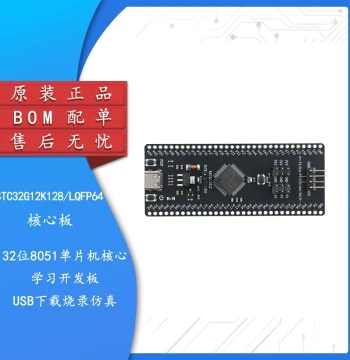
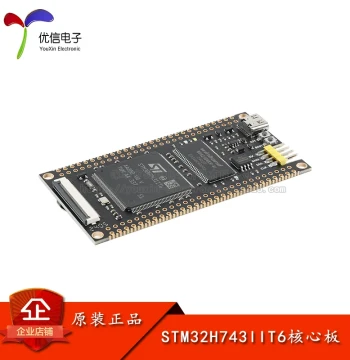
| Microcontroller Model | STM32F103ZET6 |
| Core Architecture | ARM Cortex-M3 32-bit RISC |
| Maximum Frequency | 72 MHz |
| Flash Memory | 512 KB |
| SRAM | 64 KB |
| GPIO Pins | 112 Fast I/O Ports |
| Communication Interfaces | 5 USART, 3 SPI, 2 I2C, CAN, USB |
| ADC Resolution | 12-bit with up to 21 channels |
| Operating Voltage | 2.0V to 3.6V |
| Package Type | LQFP144 |
Anonymous
Mar 27, 2026
Rating: 5/5
Best bang for your buck
Compared to other development boards in this category, the feature set here is unmatched for the price. The 512KB flash allows for complex applications without memory constraints.
Anonymous
Mar 24, 2026
Rating: 5/5
Perfect for embedded systems learning
This board is exactly what I needed for my university project. The pinout is clearly labeled, and it works flawlessly with the ST-Link debugger. Highly recommended for beginners.
Anonymous
Mar 24, 2026
Rating: 4/5
Good documentation support online
While the included manual is basic, there are tons of community resources and datasheets available for the F103 series. The hardware itself is solid and reliable.
Anonymous
Mar 22, 2026
Rating: 5/5
Robust industrial control prototype base
Used this for a small automation prototype. The multiple timers and PWM channels are very useful for motor control applications. Stable performance over continuous operation.
Anonymous
Mar 21, 2026
Rating: 4/5
Great value but needs careful handling
The board performs well and has all the peripherals I need. Just be careful with the voltage levels on the GPIO pins; a multimeter check is advised before connecting sensors.
Anonymous
Mar 12, 2026
Rating: 5/5
Excellent compatibility with CubeIDE
Set up was a breeze using STM32CubeIDE. The clock configuration tool made it easy to get the 72MHz speed running. No issues with the bootloader or flashing firmware.
Q: Is the 5V pin tolerant on all GPIO ports?
A: Most GPIO pins on the STM32F103ZET6 are 5V tolerant, but please refer to the specific datasheet section 'Pin definitions' to verify which pins support 5V input, as some analog-only pins do not.
Q: Does this board come with an onboard programmer?
A: No, this board does not have an onboard programmer. You will need an external ST-Link V2 or J-Link debugger to flash code onto the microcontroller.
Q: Can I power this board via the USB port?
A: Yes, the board can be powered via the mini-USB connector, which provides 5V to the onboard regulator. Alternatively, you can supply 5V directly to the 5V pin header.
Q: What IDEs are compatible with this development board?
A: This board is compatible with STM32CubeIDE, Keil MDK, IAR Embedded Workbench, and platformIO. It supports standard C/C++ development environments for ARM Cortex-M3.
Q: Does it support FreeRTOS out of the box?
A: Yes, the STM32F103ZET6 has sufficient RAM and Flash to run FreeRTOS. You can easily integrate it using the STM32CubeMX tool to generate the necessary initialization code.