Anonymous
Mar 23, 2026
Rating: 4/5
Good Value Sensor
The module is compact and easy to solder. Had some trouble with ambient light interference initially, but shielding fixed it. Good purchase for hobbyists.
Description
Reviews
| Brand | - |
| Category | Electronic Components / Maker DIY / Computer Hardware, Monitors & Peripherals |
| Origin | - |
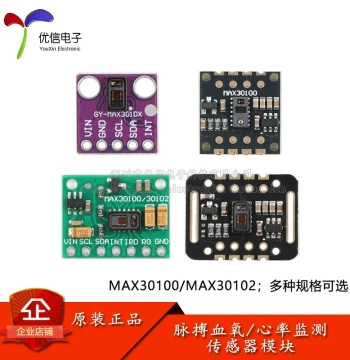
| Interface Protocol | I2C (Inter-Integrated Circuit) |
| Operating Voltage | 3.3V - 5V DC |
| LED Wavelengths | Red (660nm) and IR (880nm) |
| Chipset Model | MAX30102 (Compatible with MAX30100) |
| PCB Dimensions | 26mm x 19mm x 14mm |
| Microcontroller Compatibility | Arduino, ESP32, Raspberry Pi, STM32 |
| Power Consumption | Low Power Mode Available |
| Data Buffer | 18-Byte FIFO Buffer |
| Interrupt Output | Yes, Programmable Interrupts |
| Package Content | 1x Sensor Module, 1x Header Pin Set |
Anonymous
Mar 23, 2026
Rating: 4/5
Good Value Sensor
The module is compact and easy to solder. Had some trouble with ambient light interference initially, but shielding fixed it. Good purchase for hobbyists.
Anonymous
Mar 09, 2026
Rating: 5/5
Great for Students
Bought this for my engineering class. It helps understand how pulse oximetry works without needing expensive equipment. Shipping was quick.
Anonymous
Feb 17, 2026
Rating: 5/5
Excellent Development Board
Fast I2C communication and stable readings when calibrated properly. The library support is extensive. Highly recommend for prototyping wearables.
Anonymous
Feb 02, 2026
Rating: 5/5
Perfect for Arduino Projects
Works flawlessly with my Arduino Uno. Used it for a science fair project to demonstrate bio-sensing concepts. Not medical grade, but great for learning.
Anonymous
Jan 24, 2026
Rating: 3/5
Sensitive to Movement
Readings fluctuate a lot if the finger moves. Requires a stable setup. Good for static testing but challenging for active monitoring without extra coding.


Q: Can I use this for medical diagnosis?
A: No, this module is designed for educational and hobbyist development purposes only and is not certified for medical use.
Q: Are there libraries available for this sensor?
A: Yes, there are several open-source libraries available for Arduino and PlatformIO that support MAX30102.
Q: How close does the finger need to be?
A: The sensor requires direct contact or very close proximity (within 5mm) to detect pulse and oxygen saturation levels accurately.
Q: Is this module compatible with 5V logic?
A: Yes, the module includes a voltage regulator and level shifting, making it safe for 5V microcontrollers like Arduino Uno.
Q: What is the wiring configuration?
A: The module typically uses 4 pins: VCC, GND, SDA, and SCL. Please refer to the datasheet for specific pinout diagrams.