Anonymous
Mar 26, 2026
Rating: 5/5
Best budget light sensor
Compared to other modules in this price range, the GY-302 offers the best accuracy. It handles both low light and bright sunlight conditions within its specified range effectively.
Description
Reviews
| Brand | - |
| Category | Robotics / STEM Teaching Tools / Sensors |
| Origin | - |
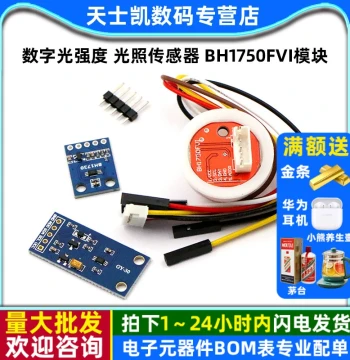
| Model Number | GY-302 |
| Sensor Type | BH1750FVI Digital Light Sensor |
| Communication Interface | I2C (Inter-Integrated Circuit) |
| Operating Voltage | 3.3V - 5V DC |
| Measurement Range | 1 - 65535 Lux |
| Resolution | 1 Lux |
| Spectral Response | Close to human eye sensitivity |
| Board Dimensions | 22mm x 18mm x 3mm |
| Pin Count | 4 Pins (VCC, GND, SCL, SDA) |
| Application | Arduino, Raspberry Pi, IoT Projects |
Anonymous
Mar 26, 2026
Rating: 5/5
Best budget light sensor
Compared to other modules in this price range, the GY-302 offers the best accuracy. It handles both low light and bright sunlight conditions within its specified range effectively.
Anonymous
Mar 23, 2026
Rating: 5/5
Perfect for my smart home project
This module works flawlessly with my Arduino Uno. The I2C communication is stable, and the readings are consistent with my standalone lux meter. Great value for the price.
Anonymous
Mar 23, 2026
Rating: 4/5
Solid performance
Works great for line following robots that need ambient light compensation. The response time is quick. Only minor issue is the silkscreen printing is slightly faint.
Anonymous
Mar 17, 2026
Rating: 5/5
Easy to integrate
As someone new to sensors, I was worried about the wiring. It turned out to be very simple: just four wires. The BH1750 chip is widely supported in most coding environments.
Anonymous
Mar 10, 2026
Rating: 5/5
Reliable and compact
I bought five of these for a greenhouse monitoring system. They have been running for three months without any drift in data. The form factor is small enough to fit anywhere.
Anonymous
Mar 09, 2026
Rating: 4/5
Good sensor, clear documentation needed
The hardware quality is excellent and soldering points are well-defined. However, beginners might struggle without a library example. Once set up, it measures light intensity accurately.
Q: Can this measure UV light intensity?
A: No, the BH1750 sensor is designed to measure visible light intensity (illuminance) in Lux. It does not specifically isolate or measure UV radiation.
Q: Is this module compatible with 5V logic levels?
A: Yes, the GY-302 module operates comfortably between 3.3V and 5V, making it compatible with both 3.3V and 5V microcontrollers like Arduino and ESP32.
Q: What is the maximum distance for I2C communication?
A: Standard I2C protocols recommend keeping cable lengths under 1 meter for reliable communication without pull-up resistor adjustments. For longer distances, an I2C extender is recommended.
Q: Does this come with a library for Python?
A: While we do not provide proprietary software, the BH1750 sensor is widely supported by open-source libraries available for Python (RPi.GPIO) and Arduino IDE.
Q: Are the pins pre-soldered?
A: No, the module is shipped with unsoldered header pins to allow for flexible mounting options. You will need to solder them yourself or use jumper wires directly.