Anonymous
Mar 30, 2026
Rating: 4/5
Solid component
Works as expected. The PCB layout is clean, and the soldering points are well-defined. Just make sure you don't exceed 5V input or you might damage the comparator.
Description
Reviews
| Brand | - |
| Category | Robotics / STEM Teaching Tools / Sensors |
| Origin | - |
| Pin Count | 4-Pin |
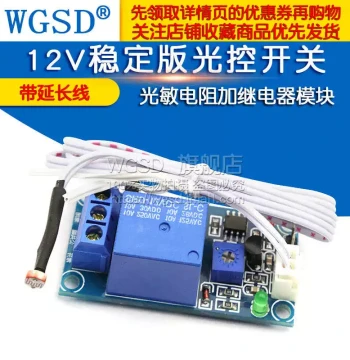
| Sensor Type | Photoresistor (LDR) |
| Operating Voltage | 3.3V - 5V DC |
| Output Signal | Digital Switch Output (DO) & Analog Output (AO) |
| Comparator Chip | LM393 |
| Sensitivity Adjustment | Potentiometer included |
| PCB Size | 32mm x 14mm |
| Mounting Hole Diameter | 3mm |
| Compatibility | Arduino, Raspberry Pi, ESP32, STM32 |
| Application | Light detection, automatic street lights, camera exposure control |
Anonymous
Mar 30, 2026
Rating: 4/5
Solid component
Works as expected. The PCB layout is clean, and the soldering points are well-defined. Just make sure you don't exceed 5V input or you might damage the comparator.
Anonymous
Mar 29, 2026
Rating: 5/5
Perfect for Arduino projects
This sensor module works flawlessly with my Arduino Uno. The analog output gives smooth readings, and the digital threshold is easy to adjust with the onboard potentiometer. Great value for the price.
Anonymous
Mar 25, 2026
Rating: 5/5
Excellent precision
The ability to tune the sensitivity makes this module versatile for different lighting conditions. I've tested it in both direct sunlight and dim indoor lighting, and it performs well in both.
Anonymous
Mar 14, 2026
Rating: 5/5
Great for learning electronics
Bought a pack of these for my university robotics club. They are robust enough to handle beginner mistakes and provide consistent data for our line-following robots.
Anonymous
Mar 11, 2026
Rating: 4/5
Good sensitivity, clear instructions needed
The hardware quality is solid and the LM393 chip is reliable. I deducted one star because there were no printed instructions on how to wire the 4 pins, but a quick online search solved it.
Anonymous
Mar 09, 2026
Rating: 5/5
Reliable light detection
I used this to build an automatic night light system. It detects dusk perfectly and triggers the relay without any false positives. The response time is very fast.
Q: How do I adjust the sensitivity of the light detection?
A: There is a blue potentiometer on the board. Use a small screwdriver to rotate it clockwise or counter-clockwise while monitoring the output until the desired light threshold is achieved.
Q: Can I use this with a Raspberry Pi?
A: Yes, you can. Connect the VCC to 5V or 3.3V, GND to ground, and the DO or AO pin to a GPIO pin. Note that if using the Analog Output, you will need an external ADC since Raspberry Pi GPIOs are digital only.
Q: Does this module output analog or digital signals?
A: This module provides both! It has an Analog Output (AO) pin for continuous light intensity readings and a Digital Output (DO) pin that switches high/low based on your threshold setting.
Q: Is the photoresistor replaceable if it breaks?
A: Yes, the photoresistor is through-hole soldered, so it can be desoldered and replaced with a standard LDR component if necessary, though they are quite durable under normal use.
Q: What is the maximum voltage this sensor can handle?
A: The operating voltage range is 3.3V to 5V DC. Please do not connect it to voltages higher than 5V, as this may permanently damage the LM393 comparator chip.