Anonymous
Mar 31, 2026
Rating: 5/5
Reliable and Consistent
I bought five of these for a solar tracking prototype. All units performed identically right out of the box. The linearity across different light intensities is impressive.
Description
Reviews
| Brand | - |
| Category | Robotics / STEM Teaching Tools / Sensors |
| Origin | - |
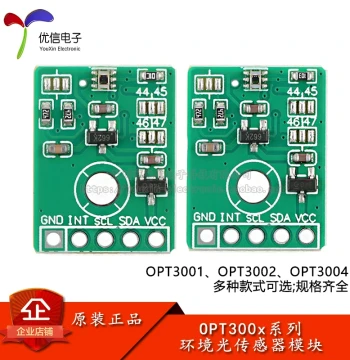
| Operating Voltage | 2.7V to 5.5V |
| Output Type | Analog Voltage |
| Spectral Response | Visible Light (400nm - 700nm) |
| Package Type | SOIC-8 Surface Mount |
| Responsivity | 0.45 A/W at 650nm |
| Dark Current | 1 nA (Typical) |
| Response Time | 10 µs |
| Operating Temperature | -40°C to +85°C |
| Integrated Component | Photodiode and Transimpedance Amplifier |
| Application | Ambient Light Sensing, Display Brightness Control |
Anonymous
Mar 31, 2026
Rating: 5/5
Reliable and Consistent
I bought five of these for a solar tracking prototype. All units performed identically right out of the box. The linearity across different light intensities is impressive.
Anonymous
Mar 29, 2026
Rating: 5/5
Perfect for Arduino Projects
This module is incredibly easy to interface with my Arduino Uno. The analog output is stable and responds quickly to changes in room lighting. Great for building an automatic night light.
Anonymous
Mar 23, 2026
Rating: 4/5
Good for indoor sensing
Works perfectly for indoor ambient light measurement. Note that it saturates in direct sunlight, so keep that in mind if your project involves outdoor use without shielding.
Anonymous
Mar 23, 2026
Rating: 5/5
Great value for money
Compared to buying a discrete photodiode and op-amp separately, this integrated solution is much cheaper and less prone to noise issues. Highly recommended for students.
Anonymous
Mar 10, 2026
Rating: 4/5
Solid performance, small footprint
The integrated amplifier saves a lot of board space. Signal quality is excellent without needing external filtering. Only wish the datasheet had more example circuits for 3.3V systems.
Anonymous
Mar 01, 2026
Rating: 5/5
Plug and play simplicity
No complex calibration needed. Connected VCC, GND, and OUT, and immediately got readable values. The response time is fast enough for real-time applications.
Q: Is there a digital output version available?
A: This specific model provides an analog voltage output proportional to light intensity. For digital output, you would need to connect this to an ADC or use a comparator circuit.
Q: How do I mount this on a breadboard?
A: Since this is an SOIC-8 surface mount package, you will need an SOIC-to-DIP adapter breakout board to easily plug it into a standard solderless breadboard.
Q: Does this module detect UV or IR light?
A: The OPT101 is primarily optimized for the visible light spectrum. While it may have minor sensitivity to near-IR, it is not designed for dedicated UV or IR detection applications.
Q: Can this sensor be directly connected to a 5V microcontroller?
A: Yes, the OPT101 operates comfortably within the 2.7V to 5.5V range, making it fully compatible with 5V logic microcontrollers like the Arduino Uno.
Q: What is the maximum current consumption of this module?
A: Under typical operating conditions at 5V, the quiescent current is approximately 0.6 mA, making it suitable for battery-powered projects.