Anonymous
Mar 29, 2026
Rating: 5/5
Reliable and stable
I've used these in several robotics projects. The I2C communication is stable, and it handles different lighting conditions well without drifting.
Description
Reviews
| Brand | - |
| Category | Robotics / STEM Teaching Tools / Sensors |
| Origin | - |
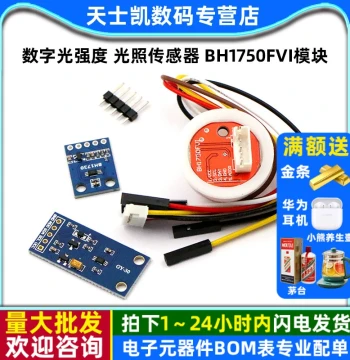
| Chip Model | BH1750FVI |
| Interface Type | I2C (Two-wire) |
| Operating Voltage | 3.3V - 5V DC |
| Measurement Range | 1 - 65535 Lux |
| Resolution | 1 Lux |
| Spectral Response | Close to human eye sensitivity |
| Conversion Time | Approx. 120ms |
| Dimensions | 22mm x 18mm x 4mm |
| Connector Type | Pre-soldered header pins with wires |
| Compatibility | Arduino, Raspberry Pi, ESP32, STM32 |
Anonymous
Mar 29, 2026
Rating: 5/5
Reliable and stable
I've used these in several robotics projects. The I2C communication is stable, and it handles different lighting conditions well without drifting.
Anonymous
Mar 28, 2026
Rating: 5/5
Easy to use for beginners
As someone new to sensors, I found this very easy to integrate. Plenty of tutorials online for Arduino. The pre-soldered wires saved me a lot of time.
Anonymous
Mar 25, 2026
Rating: 5/5
Perfect for my smart home project
This sensor works flawlessly with my ESP32. The readings are consistent and match my standalone lux meter very closely. Setup was easy using standard libraries.
Anonymous
Mar 20, 2026
Rating: 4/5
Works well for plant monitoring
Using this to monitor light levels for my indoor garden. It gives good data logs. Just make sure to calibrate it if you need absolute precision.
Anonymous
Mar 07, 2026
Rating: 4/5
Good value, accurate enough
Great little module for the price. It responds quickly to changes in light. I deducted one star because the included wires were a bit short for my enclosure, but that's a minor issue.
Anonymous
Mar 06, 2026
Rating: 5/5
Excellent sensitivity
The spectral response is indeed very close to the human eye, which is exactly what I needed for my automatic display brightness project. Highly recommended.
Q: Can this sensor detect UV light?
A: No, the BH1750FVI is designed to measure visible light intensity (Lux) with a spectral response similar to the human eye. It does not specifically measure UV radiation.

Q: What is the maximum distance for the I2C connection?
A: For reliable I2C communication, we recommend keeping the wire length under 30cm (approx. 12 inches). For longer distances, you may need an I2C extender or buffer.
Q: Does this module work with 5V Arduino Uno?
A: Yes, the BH1750FVI module operates within a voltage range of 3.3V to 5V, making it fully compatible with the 5V logic of the Arduino Uno.
Q: Is there a library available for Python on Raspberry Pi?
A: Yes, there are several open-source Python libraries available for the Raspberry Pi, such as 'bh1750' or generic I2C libraries that support this chip.
Q: How do I change the measurement resolution?
A: You can change the resolution by sending specific command codes via the I2C interface to switch between High Resolution, High Resolution Mode 2, and Low Resolution modes. Please refer to the datasheet for command hex codes.