Anonymous
Mar 26, 2026
Rating: 5/5
Best in class for the price
I have purchased ten of these for a university lab. Consistency between units is high, and the support team provided the register map quickly when I asked.
Description
Reviews
| Brand | - |
| Category | Robotics / STEM Teaching Tools / Sensors |
| Origin | - |
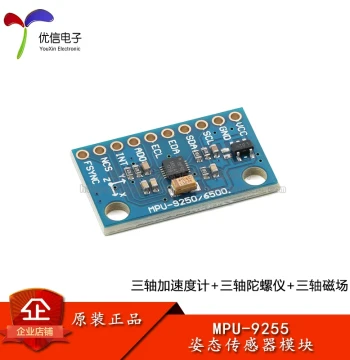
| Sensor Type | 9-Axis IMU (Accelerometer, Gyroscope, Magnetometer) |
| Communication Interface | UART, I2C, CAN |
| Operating Voltage | 3.3V - 5V DC |
| Data Update Rate | Up to 200Hz |
| Algorithm | Built-in Kalman Filter |
| Dimensions | 23mm x 17mm x 4mm |
| Weight | 3.5 grams |
| Working Temperature | -40°C to +85°C |
| Output Data | Angle, Angular Velocity, Acceleration, Magnetic Field |
| Compatibility | Arduino, STM32, Raspberry Pi, ESP32 |
Anonymous
Mar 26, 2026
Rating: 5/5
Best in class for the price
I have purchased ten of these for a university lab. Consistency between units is high, and the support team provided the register map quickly when I asked.
Anonymous
Mar 26, 2026
Rating: 4/5
Great value, minor documentation gaps
Hardware works flawlessly and the price is unbeatable. The UART protocol is straightforward, but I wish the English manual had more examples for the CAN bus interface.
Anonymous
Mar 25, 2026
Rating: 5/5
Perfect for my DIY drone project
The Kalman filter integration makes a huge difference. The angle data is stable and smooth right out of the box. Much easier to work with than raw MPU6050 modules.
Anonymous
Mar 20, 2026
Rating: 5/5
Reliable attitude estimation
Using this for a balancing robot. The drift is minimal thanks to the onboard processing. Saves a lot of CPU cycles on my microcontroller since I don't need to run the fusion algorithm myself.
Anonymous
Mar 10, 2026
Rating: 4/5
Good but needs careful mounting
Performance is excellent once mounted correctly. Make sure to isolate it from motor vibrations if you are using it on a vehicle, otherwise, the accelerometer readings get noisy.
Anonymous
Mar 02, 2026
Rating: 5/5
Solid build quality
I've tested this against a much more expensive industrial sensor, and the results are surprisingly close for hobbyist applications. The magnetic calibration was easy to perform.
Q: Can I power this directly from a 5V USB source?
A: Yes, the module supports a wide input voltage range of 3.3V to 5V, so connecting it directly to a 5V USB pin is safe and recommended.
Q: Do you provide a Python library for reading data on Raspberry Pi?
A: Yes, we host a basic Python example script on our GitHub repository that demonstrates how to read data via I2C and UART on Raspberry Pi and other Linux-based systems.
Q: Is the magnetometer affected by nearby motors?
A: Like all magnetic sensors, it can be influenced by strong electromagnetic fields. We recommend mounting the sensor away from motors and power cables, or performing dynamic calibration in your software.
Q: What is the default baud rate for UART communication?
A: The factory default baud rate is 115200 bps. This can be changed to other standard rates like 9600 or 57600 using our configuration tool or by sending specific command frames.
Q: Does this module require an external microcontroller to calculate the tilt angle?
A: No, the JY901S has an onboard processor that runs the Kalman filter algorithm. It outputs the calculated angles directly via UART or I2C, saving your main MCU resources.