Anonymous
Mar 23, 2026
Rating: 5/5
Excellent for educational kits
We bought ten of these for our university robotics lab. Students find them easy to wire up, and the data consistency is impressive for this price point.
Description
Reviews
| Brand | - |
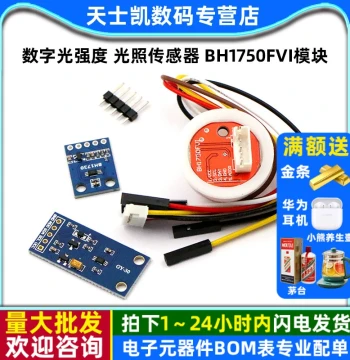
| Category | Robotics / STEM Teaching Tools / Sensors |
| Origin | - |
| Model Number | JBH1750 |
| Sensor Type | Photodiode Chip |
| Operating Voltage | 3.3V - 5V DC |
| Output Signal | Analog Voltage |
| Spectral Response | 400nm - 700nm |
| Response Time | < 20ms |
| Operating Temperature | -20°C to +85°C |
| Interface | 3-Pin Header (VCC, GND, OUT) |
| Dimensions | 15mm x 10mm x 4mm |
| Application | Ambient Light Detection, Display Brightness Control |
Anonymous
Mar 23, 2026
Rating: 5/5
Excellent for educational kits
We bought ten of these for our university robotics lab. Students find them easy to wire up, and the data consistency is impressive for this price point.
Anonymous
Mar 20, 2026
Rating: 5/5
Compact and reliable
Small form factor makes it easy to fit into tight enclosures. It has been running continuously for two weeks without any drift in readings.
Anonymous
Mar 10, 2026
Rating: 5/5
Great for plant monitoring
Using this to monitor light levels for my indoor garden setup. It triggers my grow lights perfectly when ambient light drops below a certain level.
Anonymous
Mar 06, 2026
Rating: 4/5
Good sensitivity, easy to integrate
I used this for a smart home prototype. The photodiode chip is quite sensitive. I had to adjust the threshold in my code slightly, but overall it performed well.
Anonymous
Mar 06, 2026
Rating: 5/5
Perfect for my Arduino project
This sensor module works flawlessly with my Arduino Uno. The analog output is stable and responds quickly to changes in room lighting. Great value for the price.
Anonymous
Mar 01, 2026
Rating: 4/5
Works as advertised
Solid build quality. The pins are well-soldered. Only minor issue is that the datasheet could be more detailed regarding lux conversion formulas.
Q: Does this come with a library for ESP32?
A: While we do not provide a proprietary library, the module works with standard analog read functions. Many community-created libraries for generic photodiodes work seamlessly with the ESP32.
Q: Is this module compatible with Raspberry Pi?
A: Yes, the JBH1750 is compatible with Raspberry Pi. Since it outputs an analog signal, you will need an external ADC (Analog-to-Digital Converter) like the MCP3008 to read the data via GPIO pins.
Q: What is the maximum lux range this sensor can detect?
A: The JBH1750 is optimized for typical indoor ambient light conditions, generally ranging from 1 to 10,000 Lux. It may saturate in direct sunlight.
Q: What is the power consumption of this module?
A: The module is very energy efficient, typically consuming less than 0.5mA during active operation, making it suitable for battery-powered applications.
Q: Can I use this outdoors in the rain?
A: No, the JBH1750 module is not waterproof. If you intend to use it outdoors, you must house it in a weatherproof enclosure with a transparent window for the sensor.