Anonymous
Mar 25, 2026
Rating: 4/5
Good accuracy, easy setup
Used this to automate my living room lights based on ambient light. It's quite accurate compared to my phone's sensor. Only wish the pins were labeled more clearly on the back.
Description
Reviews
| Brand | - |
| Category | Robotics / STEM Teaching Tools / Sensors |
| Origin | - |
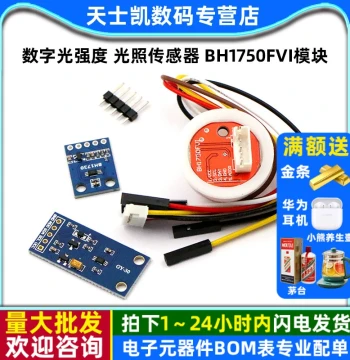
| Model Number | GY-30 / BH1750FVI |
| Operating Voltage | 3.3V - 5V DC |
| Interface Type | I2C (Two-Wire Serial) |
| Measurement Range | 1 - 65535 Lux |
| Resolution | 1 Lux |
| Spectral Response | Close to Human Eye Sensitivity |
| Conversion Time | Approx. 120ms |
| Board Dimensions | 22mm x 18mm x 3mm |
| Mounting Holes | 2 x 3mm Diameter |
| Compatibility | Arduino, Raspberry Pi, ESP32, STM32 |
Anonymous
Mar 25, 2026
Rating: 4/5
Good accuracy, easy setup
Used this to automate my living room lights based on ambient light. It's quite accurate compared to my phone's sensor. Only wish the pins were labeled more clearly on the back.
Anonymous
Mar 25, 2026
Rating: 5/5
Reliable I2C communication
Integrated this into a mobile robot for line following and environmental mapping. The I2C address is standard, and it plays nice with other sensors on the bus.
Anonymous
Mar 16, 2026
Rating: 4/5
Works well outdoors with protection
I enclosed it in a waterproof case for my garden monitoring system. It handles sunlight variations well, though direct noon sun maxes out the reading slightly.
Anonymous
Mar 14, 2026
Rating: 5/5
Perfect for Arduino Projects
This sensor works flawlessly with my Arduino Uno. The library support is excellent, and reading lux values was straightforward. Great value for the price.
Anonymous
Mar 08, 2026
Rating: 5/5
Great starter sensor
As a beginner, I found this very easy to wire up. Plenty of tutorials online. It responded immediately to changes in light intensity in my room.
Anonymous
Mar 07, 2026
Rating: 5/5
Consistent readings
Very stable output. No noisy data spikes like some cheaper photoresistors. The digital output saves me from having to calibrate an ADC.
Q: Can I use this to measure UV index?
A: No, this sensor measures visible light intensity (Lux) and is calibrated to human eye sensitivity. It does not specifically measure UV radiation.
Q: What is the default I2C address for this sensor?
A: The default I2C address is typically 0x23. Some variants may use 0x5C depending on the ADDR pin configuration, but 0x23 is the most common for this breakout.
Q: Does this module work with 5V logic levels directly?
A: Yes, the GY-30 module includes a voltage regulator and level shifting, so it can be safely connected to 5V microcontrollers like the Arduino Uno.
Q: How do I change the measurement resolution?
A: Resolution is changed via software commands sent over I2C. You can select between High, Low, or Auto-resolution modes by writing specific configuration bytes to the sensor.
Q: Is there a library available for ESP32?
A: Yes, there are several open-source libraries available in the Arduino IDE Library Manager that support the BH1750 sensor on ESP32 platforms.