Anonymous
Mar 28, 2026
Rating: 5/5
Kids loved building with it
Bought this for my son's science fair project. It was durable enough to withstand several crashes during testing. The LED indicator is bright and helpful for debugging connections.
Description
Reviews
| Brand | - |
| Category | Robotics / STEM Teaching Tools / Sensors |
| Origin | - |
| Operating Voltage | 3.3V - 5V DC |
| Output Signal | Digital Switching Output (0 and 1) |
| Detection Angle | Approximately 180 degrees |
| Effective Distance | 2mm - 5mm (adjustable via potentiometer) |
| Comparator Chip | LM393 |
| PCB Dimensions | 32mm x 14mm x 8mm |
| Mounting Hole Diameter | 3.1mm |
| Interface Type | 3-Pin PH2.0 Connector or Dupont Headers |
| Compatibility | Arduino, Raspberry Pi, STM32, ESP8266 |
| Package Contents | 1x Collision Sensor Module, 1x Jumper Wire Set |
Anonymous
Mar 28, 2026
Rating: 5/5
Kids loved building with it
Bought this for my son's science fair project. It was durable enough to withstand several crashes during testing. The LED indicator is bright and helpful for debugging connections.
Anonymous
Mar 26, 2026
Rating: 5/5
Great starter sensor
As someone new to electronics, this module was very forgiving. The digital output makes logic simple to understand. It helped me finally get my line-following car to stop before hitting walls.
Anonymous
Mar 14, 2026
Rating: 5/5
Perfect for my obstacle-avoiding robot
This sensor works flawlessly with my Arduino Uno project. The detection range is easily adjustable using the onboard potentiometer, and it reacts instantly to obstacles. Great value for the price.
Anonymous
Mar 10, 2026
Rating: 4/5
Good sensitivity, easy to wire
I used this for a university robotics assignment. Wiring was straightforward, and the code examples found online worked immediately. Deducted one star because the mounting holes are a bit tight for standard screws.
Anonymous
Mar 09, 2026
Rating: 5/5
Reliable and compact
Small form factor makes it easy to mount on small chassis. I've tested it against various materials like wood, plastic, and metal, and it detects them all consistently within the specified range.
Anonymous
Mar 02, 2026
Rating: 4/5
Solid performance for the cost
Used a batch of ten for a classroom kit. Nine worked perfectly out of the box; one needed a slight re-solder of the header pins. Overall, excellent reliability for educational purposes.
Q: Can this sensor detect glass or transparent objects?
A: Detection of transparent objects like clear glass can be inconsistent depending on lighting conditions and the angle of incidence. It works best with opaque surfaces.
Q: Does this module come with jumper wires included?
A: Yes, the package typically includes a set of basic jumper wires to help you get started immediately with your breadboard or microcontroller.
Q: What is the maximum current draw of this module?
A: The module consumes approximately 10mA to 20mA when active, which is well within the power limits of standard Arduino pins.
Q: Is there a library specifically required for this sensor?
A: No specific library is needed. Since it outputs a simple digital HIGH/LOW signal, you can read it using the standard digitalRead() function in the Arduino IDE.
Q: How do I adjust the detection distance?
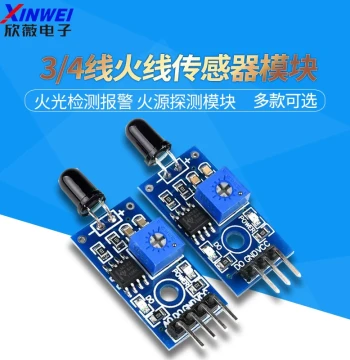
A: There is a blue potentiometer on the board. Turn it clockwise to increase sensitivity (distance) and counter-clockwise to decrease it. Use a small screwdriver for fine adjustments.