Anonymous
Mar 23, 2026
Rating: 5/5
Robust and reliable
I have been using this board for industrial sensor prototyping. The stability at 72MHz is impressive, and the multiple communication interfaces make integration easy.
Description
Reviews
| Brand | - |
| Category | Robotics / STEM Teaching Tools / Development, Learning, Evaluation & Industrial Control Boards |
| Origin | - |
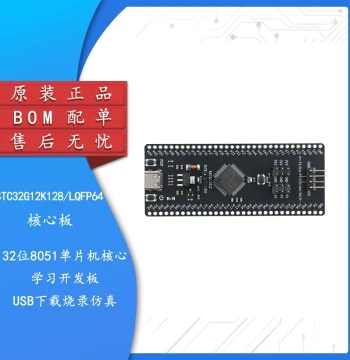
| Microcontroller Model | STM32F103ZET6 |
| Architecture | ARM Cortex-M3 32-bit RISC |
| Maximum Frequency | 72 MHz |
| Flash Memory | 512 KB |
| SRAM | 64 KB |
| I/O Ports | 112 Fast I/Os (5V tolerant) |
| Communication Interfaces | 5 USARTs, 3 SPIs, 2 I2Cs, CAN, USB 2.0 |
| ADC Resolution | 12-bit, up to 21 channels |
| Operating Voltage | 2.0V to 3.6V |
| Board Dimensions | 85mm x 55mm |
Anonymous
Mar 23, 2026
Rating: 5/5
Robust and reliable
I have been using this board for industrial sensor prototyping. The stability at 72MHz is impressive, and the multiple communication interfaces make integration easy.
Anonymous
Mar 20, 2026
Rating: 5/5
Perfect for learning ARM architecture
This board is exactly what I needed to transition from Arduino to professional embedded development. The pinout is clearly labeled, and it works flawlessly with the ST-Link debugger.
Anonymous
Mar 16, 2026
Rating: 4/5
Good starter board
Works well with Keil and STM32CubeIDE. The only downside is that the USB connector feels slightly fragile, so handle with care during frequent flashing.
Anonymous
Mar 11, 2026
Rating: 5/5
Standard industry tool
If you are serious about embedded C programming, this is the standard board to start with. The 512KB flash allows for substantial application code testing.
Anonymous
Mar 10, 2026
Rating: 5/5
Excellent for university projects
Used this for my final year embedded systems project. It handled complex RTOS tasks without breaking a sweat. Highly recommend for students on a budget.
Anonymous
Mar 04, 2026
Rating: 4/5
Great value, minor documentation gaps
Hardware quality is solid and the chip is genuine. I deducted one star because the included schematic could be more detailed for custom peripheral expansion, but online resources fill the gap.
Q: Can I drive 5V logic sensors directly?
A: Many of the GPIO pins on the STM32F103ZET6 are 5V tolerant, meaning they can accept 5V input signals without damage, but they output 3.3V logic levels.
Q: What is the power supply requirement?
A: The board can be powered via the USB port (5V) or through the VIN pin (recommended 7V-12V). The onboard regulator steps this down to 3.3V for the MCU.
Q: Is this compatible with the Arduino IDE?
A: Yes, you can use this board with the Arduino IDE by installing the appropriate STM32 core package via the Board Manager, though native STM32CubeIDE is recommended for full feature access.
Q: Does this board come with an onboard debugger?
A: No, this board does not have an onboard debugger. You will need a separate ST-Link V2 or J-Link programmer to upload code and debug.
Q: Does it support FreeRTOS?
A: Yes, the STM32F103ZET6 has sufficient RAM and processing power to run FreeRTOS. You can easily integrate it using the STM32CubeMX configuration tool.