Anonymous
Mar 31, 2026
Rating: 5/5
Tiny but mighty
I used three of these in a custom drone controller. The small form factor saved me a lot of space on the PCB. No issues with power consumption or heat generation.
Description
Reviews
| Brand | - |
| Category | Robotics / STEM Teaching Tools / Development, Learning, Evaluation & Industrial Control Boards |
| Origin | - |
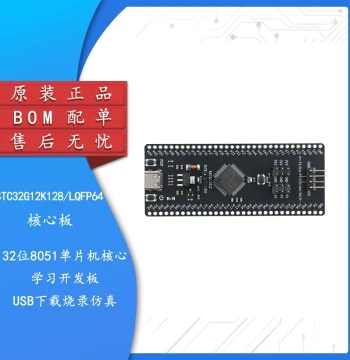
| Microcontroller | STM32F030F4P6 |
| Architecture | ARM Cortex-M0 32-bit RISC |
| Max Frequency | 48 MHz |
| Flash Memory | 16 KB |
| SRAM | 4 KB |
| GPIO Pins | 25 Available I/O Ports |
| Operating Voltage | 3.3V DC |
| Interface Support | SWD, USART, SPI, I2C |
| Board Dimensions | 20mm x 17mm |
| Package Type | TSSOP20 |
Anonymous
Mar 31, 2026
Rating: 5/5
Tiny but mighty
I used three of these in a custom drone controller. The small form factor saved me a lot of space on the PCB. No issues with power consumption or heat generation.
Anonymous
Mar 26, 2026
Rating: 4/5
Solid performance, minimal docs
The hardware quality is excellent and the chip runs stable at 48MHz. However, beginners might struggle slightly as the included documentation is sparse. You need to know how to set up the toolchain yourself.
Anonymous
Mar 26, 2026
Rating: 5/5
Reliable for industrial prototypes
We use these for initial proof-of-concept stages in our industrial control projects. They are reliable, cheap enough to risk in early testing, and perform consistently.
Anonymous
Mar 24, 2026
Rating: 5/5
Perfect for small embedded projects
This board is incredibly compact and works flawlessly with the STM32CubeIDE. The pinout is clearly labeled, making it easy to prototype without a breadboard. Great value for the price.
Anonymous
Mar 07, 2026
Rating: 5/5
Great for learning ARM Cortex-M0
Bought this for my university embedded systems course. It's much cheaper than the official Nucleo boards but offers similar core functionality. Flashing via SWD was straightforward.
Anonymous
Mar 07, 2026
Rating: 3/5
Good board, fragile pins
The chip itself is great, but the pre-soldered headers feel a bit thin. I accidentally bent one while plugging in a jumper wire. Be careful when handling the connections.
Q: How much current can the GPIO pins source?
A: Each GPIO pin can typically source or sink up to 25mA. However, the total current summed across all ports should not exceed the limits specified in the official STM32F030x4/x6 datasheet to avoid damaging the chip.
Q: What is the input voltage range for the VIN pin?
A: While the MCU operates at 3.3V, many versions of this board include an LDO regulator allowing VIN input between 3.6V and 5.5V. Please check the specific silkscreen on your board to confirm the presence of an LDO before connecting higher voltages.
Q: Does this board come with a built-in programmer?
A: No, this core board does not have an onboard ST-Link programmer. You will need an external ST-Link V2 or compatible debugger to flash code via the SWD interface.
Q: Is this compatible with Arduino IDE?
A: Yes, it is compatible with the Arduino IDE if you install the appropriate STM32 board support package (by STMicroelectronics or Generic STM32). You may need to select the correct generic board definition matching the F030F4P6.
Q: Are the boot jumpers included?
A: The board usually has pads for BOOT0 and BOOT1 configuration. Jumpers are often not included in the package to keep costs low, so you may need to use dupont wires or solder your own headers for boot mode selection.