Anonymous
Mar 16, 2026
Rating: 4/5
Great value, minor soldering needed
The chip works flawlessly at 72MHz. Note that the header pins were not pre-soldered on my unit, so be prepared to do a little work. Once set up, it runs stable for days.
Description
Reviews
| Brand | - |
| Category | Robotics / STEM Teaching Tools / Development, Learning, Evaluation & Industrial Control Boards |
| Origin | - |
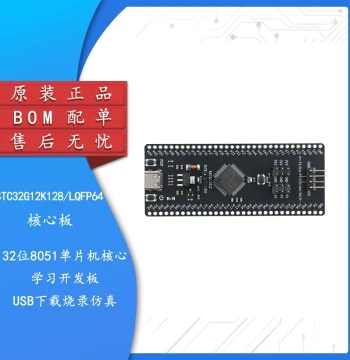
| Microcontroller Model | STM32F103C8T6 |
| Core Architecture | ARM Cortex-M3 32-bit RISC |
| Maximum Frequency | 72 MHz |
| Flash Memory | 64 KB |
| SRAM | 20 KB |
| Operating Voltage | 2.0V to 3.6V (3.3V recommended) |
| GPIO Pins | 37 Available I/O Ports |
| Communication Interfaces | 3x USART, 2x SPI, 2x I2C, USB, CAN |
| Board Dimensions | 53mm x 23mm x 10mm |
| Included Resources | Free PDF Tutorial and Example Code |
Anonymous
Mar 16, 2026
Rating: 4/5
Great value, minor soldering needed
The chip works flawlessly at 72MHz. Note that the header pins were not pre-soldered on my unit, so be prepared to do a little work. Once set up, it runs stable for days.
Anonymous
Mar 13, 2026
Rating: 5/5
Compact and powerful
Don't let the small size fool you; this thing packs a punch. I used it for a data logging project with an SD card module, and the speed is impressive compared to 8-bit controllers.
Anonymous
Mar 11, 2026
Rating: 5/5
Reliable for prototyping
Used this to prototype a motor control algorithm before moving to a custom PCB. The performance matched the datasheet perfectly. Excellent consistency across multiple units.
Anonymous
Mar 09, 2026
Rating: 5/5
Bought 10 for our university lab
We purchased these for our introductory embedded systems course. All boards tested successfully out of the box. The price point allows us to equip every student without breaking the budget.
Anonymous
Mar 04, 2026
Rating: 5/5
Perfect for learning ARM architecture
This board is exactly what I needed to transition from Arduino to STM32. The pinout is clearly labeled, and the included tutorial made setting up the IDE very straightforward. Highly recommended for students.
Anonymous
Mar 02, 2026
Rating: 4/5
Good documentation support
As a beginner, I was worried about the learning curve. The free tutorial mentioned in the description actually exists and is quite helpful. Took off one star because the USB connector feels a bit fragile.
Q: What is the maximum current this board can supply on the 3.3V pin?
A: The onboard LDO regulator can typically supply up to 200mA, but we recommend keeping the load under 100mA for stability. For higher current requirements, please power your peripherals externally.
Q: Is this compatible with the Arduino IDE?
A: Yes, you can program this board using the Arduino IDE by installing the appropriate STM32 core packages (such as STM32duino). However, for advanced features, we recommend using STM32CubeIDE or Keil.
Q: Are the header pins included in the package?
A: The board comes with the male header pins loose in a small bag. They are not pre-soldered to allow for flexible mounting options (e.g., soldering female headers or using breadboards directly).
Q: Does this board come with a built-in programmer or do I need an ST-Link?
A: This specific Mini System Board does not have a built-in programmer. You will need an external ST-Link V2 or similar debugger/programmer to upload code via the SWD interface.
Q: Can I use this for 5V logic projects?
A: No, the STM32F103C8T6 is a 3.3V device. Applying 5V directly to the GPIO pins may damage the microcontroller. You must use level shifters if interfacing with 5V sensors or modules.