Anonymous
Mar 20, 2026
Rating: 5/5
Perfect for Raspberry Pi integration
Connected this to my Pi 4 without any level shifters. The Python library available online works smoothly. Great for monitoring ambient light conditions automatically.
Description
Reviews
| Brand | - |
| Category | Electronic Components / Maker DIY / Computer Hardware, Monitors & Peripherals |
| Origin | - |
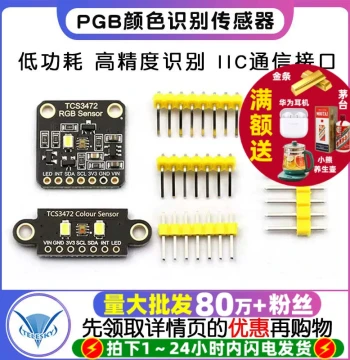
| Interface Type | I2C / TWI |
| Operating Voltage | 3.3V - 5V DC |
| Spectral Channels | 11 Channels (Including Flicker) |
| Communication Protocol | Standard I2C |
| Operating Temperature | -40°C to 85°C |
| Module Dimensions | 25mm x 17mm x 3mm |
| Net Weight | 3.5 grams |
| Power Consumption | Typical 2.5mA @ 3.3V |
| Compatible Platforms | Arduino, Raspberry Pi, ESP32 |
| Sensor Chip | AMS AS7341 |
Anonymous
Mar 20, 2026
Rating: 5/5
Perfect for Raspberry Pi integration
Connected this to my Pi 4 without any level shifters. The Python library available online works smoothly. Great for monitoring ambient light conditions automatically.
Anonymous
Mar 16, 2026
Rating: 5/5
High precision spectral data
Impressed by the 11-channel output. It allows for detailed analysis of light sources beyond just simple brightness. Shipping was fast and packaging was secure.
Anonymous
Mar 12, 2026
Rating: 5/5
Reliable and compact
Small form factor fits easily into my enclosure. The voltage range is flexible which helps when switching between 3.3V and 5V microcontrollers. Highly recommended.
Anonymous
Feb 22, 2026
Rating: 4/5
Good sensor, documentation could be better
The hardware works great and the I2C communication is stable. However, finding the right library took some searching. Once set up, the lux measurements are very reliable.
Anonymous
Jan 23, 2026
Rating: 5/5
Excellent accuracy for hobby projects
I used this module to calibrate a lighting system for my home studio. The color temperature readings are consistent and match my professional meter closely. Easy to wire up with an Arduino Uno.
Q: Is this module compatible with 5V Arduino boards?
A: Yes, the module supports an operating voltage range of 3.3V to 5V, so it is directly compatible with 5V Arduino boards like the Uno.
Q: Are there sample libraries available for ESP32?
A: Yes, there are several open-source libraries available on GitHub that support ESP32. We recommend checking the community repositories for the latest updates.
Q: Does this sensor measure UV index?
A: No, the AS7341 chip is designed for the visible spectrum. It does not measure ultraviolet (UV) radiation levels.
Q: Can this measure flicker frequency?
A: Yes, the AS7341 includes specific channels dedicated to flicker detection, allowing you to analyze light source stability.
Q: What is the default I2C address?
A: The default I2C address is typically 0x49. Please refer to the datasheet if you need to configure alternative addresses.