Anonymous
Mar 19, 2026
Rating: 3/5
Works but documentation is sparse
The hardware works fine once connected, but I had to dig through forums to find the correct register addresses for configuration. More detailed datasheets would help beginners.
Description
Reviews
| Brand | - |
| Category | Robotics / STEM Teaching Tools / Sensors |
| Origin | - |
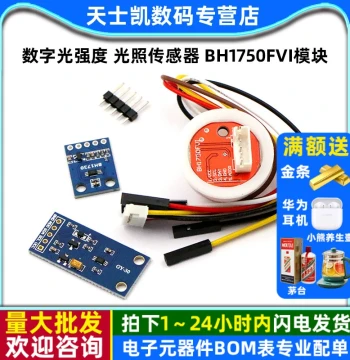
| Model Number | TSL2584 |
| Brand | Youxin Electronics |
| Interface Type | I2C Digital |
| Supply Voltage | 2.7V to 3.6V |
| Operating Temperature | -30°C to 70°C |
| Dynamic Range | 1 to 600,000 Lux |
| Package Type | Breakout Board |
| Dimensions | 15mm x 12mm x 3mm |
| Application | Ambient Light Sensing |
| Weight | 2 grams |
Anonymous
Mar 19, 2026
Rating: 3/5
Works but documentation is sparse
The hardware works fine once connected, but I had to dig through forums to find the correct register addresses for configuration. More detailed datasheets would help beginners.
Anonymous
Mar 18, 2026
Rating: 5/5
Reliable for automation systems
I used five of these in a smart lighting system. They provide consistent data over weeks of operation. The digital output eliminates noise issues common with analog sensors.
Anonymous
Mar 18, 2026
Rating: 4/5
Good accuracy, small footprint
The readings are quite accurate compared to my professional lux meter. The board is compact, which fits well in my prototype enclosure. Only wish the pin headers were pre-soldered.
Anonymous
Mar 17, 2026
Rating: 4/5
Solid performance
Fast response time and easy to integrate with Raspberry Pi. The voltage levels are compatible with 3.3V logic, saving me from needing a level shifter.
Anonymous
Mar 05, 2026
Rating: 5/5
Great value for money
For the price, you cannot beat this sensor. It handles a wide range of light conditions from dark rooms to direct sunlight without saturating immediately.
Anonymous
Mar 02, 2026
Rating: 5/5
Perfect for Arduino projects
This sensor module works flawlessly with my Arduino Uno. The I2C communication is stable, and the library support is excellent. Highly recommended for hobbyists.
Q: What is the I2C address for this device?
A: The default I2C address is usually 0x39, but some variations allow address selection via a specific pin. Please refer to the pinout diagram on the back of the module or the downloadable datasheet.
Q: Is this module compatible with 5V microcontrollers like the standard Arduino Uno?
A: Yes, the module operates on 2.7V to 3.6V, but the breakout board typically includes a voltage regulator and level shifting, making it safe to connect to 5V logic pins. Please check the specific schematic included in the package.
Q: Does this come with a library for ESP32?
A: While we do not provide a proprietary library, this sensor uses standard I2C registers. Many open-source libraries available for the TSL258x series on GitHub are fully compatible with the ESP32.
Q: Can I use this outdoors in the rain?
A: The sensor module itself is not waterproof. If you plan to use it outdoors, you must house it in a waterproof enclosure with a transparent window that allows light to pass through.
Q: What is the maximum lux rating before the sensor saturates?
A: The TSL2584 has a dynamic range up to approximately 600,000 Lux, depending on the integration time and gain settings configured via the I2C interface.