Anonymous
Mar 17, 2026
Rating: 5/5
Reliable and compact
Used this on a mobile robot to detect dark areas. The response time is quick, and the small form factor fits perfectly on the chassis. Highly recommended for robotics applications.
Description
Reviews
| Brand | - |
| Category | Robotics / STEM Teaching Tools / Sensors |
| Origin | - |
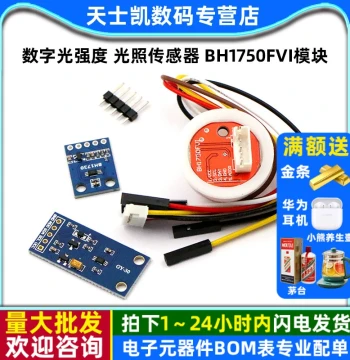
| Sensor Chip | BH1750FVI |
| Interface | I2C (Two-Wire Serial) |
| Voltage Supply | 3.3V - 5V DC |
| Measurement Range | 1 - 65535 Lux |
| Resolution | 1 Lux |
| Operating Temperature | -40°C to +85°C |
| Board Dimensions | 16mm x 20mm |
| Weight | 2.5 grams |
| Pin Count | 4 Pins (VCC, GND, SDA, SCL) |
| Compatibility | Arduino, Raspberry Pi, ESP32, STM32 |
Anonymous
Mar 17, 2026
Rating: 5/5
Reliable and compact
Used this on a mobile robot to detect dark areas. The response time is quick, and the small form factor fits perfectly on the chassis. Highly recommended for robotics applications.
Anonymous
Mar 16, 2026
Rating: 5/5
Excellent precision
The dynamic range is impressive. It handles both low-light indoor conditions and bright outdoor sunlight without saturating immediately. A must-have component for any electronics bench.
Anonymous
Mar 16, 2026
Rating: 5/5
Perfect for my smart home project
This BH1750 module works flawlessly with my ESP32. The I2C communication is stable, and the lux readings are consistent with my professional light meter. Great value for the price.
Anonymous
Mar 15, 2026
Rating: 4/5
Good sensor, clear documentation needed
The hardware quality is excellent and soldering was easy. However, beginners might struggle slightly without a dedicated library example. Once set up, it measures ambient light very accurately.
Anonymous
Mar 06, 2026
Rating: 4/5
Works as advertised
Simple to connect to Arduino Uno. The data output is straightforward. I deducted one star only because the pin headers were not included, so I had to solder them myself.
Anonymous
Mar 04, 2026
Rating: 5/5
Great for plant monitoring
I integrated this into my automated greenhouse system to monitor sunlight exposure for my plants. It has been running outdoors in a protective case for months without issues.
Q: Is there a library available for Python on Raspberry Pi?
A: Yes, there are several open-source Python libraries available for the BH1750 on Raspberry Pi, such as 'bh1750' via pip, which simplifies reading lux values.
Q: How do I change the measurement resolution?
A: The resolution can be configured via software commands sent over the I2C bus. You can select between High, High2, Low, and Power Down modes in your code.
Q: Can this sensor measure UV index?
A: No, the BH1750 is designed specifically for visible light illuminance (Lux) detection and does not measure UV radiation or UV index.
Q: What is the maximum distance for I2C communication with this sensor?
A: For reliable I2C communication, we recommend keeping the cable length under 30cm (12 inches). For longer distances, you may need an I2C extender or buffer.
Q: Does this module work with 5V logic levels directly?
A: Yes, the BH1750 module supports a voltage supply range of 3.3V to 5V, making it compatible with both 3.3V and 5V microcontrollers like Arduino Uno and ESP32.