Anonymous
Mar 25, 2026
Rating: 5/5
Great for learning electronics
Bought this for a university project. The documentation online is plentiful, and the module itself is robust. Easy to integrate into circuits.
Description
Reviews
| Brand | - |
| Category | Robotics / STEM Teaching Tools / Sensors |
| Origin | - |
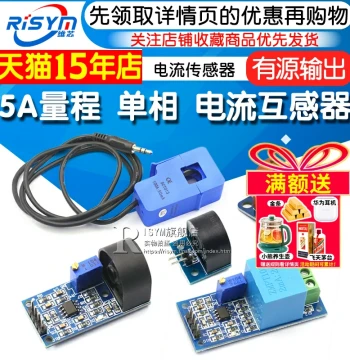
| Sensor Type | Hall Effect Current Sensor |
| Available Ranges | 5A, 20A, 30A |
| Operating Voltage | 5V DC |
| Output Sensitivity (5A) | 185 mV/A |
| Output Sensitivity (20A) | 100 mV/A |
| Output Sensitivity (30A) | 66 mV/A |
| Response Time | 5 µs |
| Isolation Voltage | 2.1 kV RMS |
| Interface | Analog Output |
| Compatibility | Arduino, Raspberry Pi, STM32 |
Anonymous
Mar 25, 2026
Rating: 5/5
Great for learning electronics
Bought this for a university project. The documentation online is plentiful, and the module itself is robust. Easy to integrate into circuits.
Anonymous
Mar 22, 2026
Rating: 4/5
Solid build quality
The PCB looks well-made and the terminals are secure. Just make sure you select the correct range for your application to get the best resolution.
Anonymous
Mar 20, 2026
Rating: 5/5
Bulk purchase success
Ordered ten of these for our makerspace. All units tested perfectly out of the box. A staple component for our power supply workshops.
Anonymous
Mar 17, 2026
Rating: 5/5
Perfect for Arduino projects
This module works flawlessly with my Arduino Uno. The readings are stable and the calibration was straightforward. Great value for the price.
Anonymous
Mar 09, 2026
Rating: 4/5
Good accuracy, needs filtering
The sensor is accurate, but I had to add some software filtering to smooth out the noise in the analog reading. Otherwise, it performs as expected.
Anonymous
Mar 03, 2026
Rating: 5/5
Reliable current monitoring
I used the 20A version to monitor battery discharge on my robot. It has been running for weeks without any issues. Highly recommended.
Q: Does this come with screw terminals or do I need to solder wires?
A: Most versions of this module come with pre-soldered screw terminals for easy connection of high-current wires, though some bare board variants may require soldering.
Q: How do I calibrate the sensor for more accurate readings?
A: You can calibrate by measuring the output voltage at zero current and at a known load current, then adjusting your code's scaling factor accordingly.
Q: What is the maximum voltage I can apply to the VCC pin?
A: The operating voltage range is typically 4.5V to 5.5V. Please do not exceed 5.5V to avoid damaging the sensor chip.
Q: Is electrical isolation provided between the high current path and the logic pins?
A: Yes, the Hall effect technology provides galvanic isolation between the current conduction path and the signal processing circuitry, rated up to 2.1 kV RMS.
Q: Can this sensor measure AC current as well as DC?
A: Yes, the ACS712 and ACS724 modules can measure both AC and DC current. The output voltage will center around VCC/2 for zero current and vary proportionally.