Anonymous
Mar 27, 2026
Rating: 5/5
Compact and Reliable
Excellent build quality. The tiny form factor fits perfectly into my custom wearable device. It handles rapid changes in light intensity without lag.
Description
Reviews
| Brand | - |
| Category | Robotics / STEM Teaching Tools / Sensors |
| Origin | - |
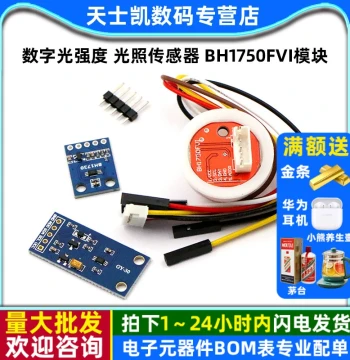
| Model Number | TSL2584TSV |
| Communication Interface | I2C (Inter-Integrated Circuit) |
| Supply Voltage | 2.4V to 3.6V |
| Operating Temperature | -30°C to +70°C |
| Dynamic Range | 1 to 40,000 Lux |
| Package Type | 6-pin TSV (Top Side View) |
| Spectral Response | Approximates Human Eye Response |
| Integration Time | Programmable (100ms to 600ms) |
| Application | Display Backlight Control, Ambient Light Sensing |
| Dimensions | 2.0mm x 2.0mm x 0.7mm |
Anonymous
Mar 27, 2026
Rating: 5/5
Compact and Reliable
Excellent build quality. The tiny form factor fits perfectly into my custom wearable device. It handles rapid changes in light intensity without lag.
Anonymous
Mar 19, 2026
Rating: 4/5
Accurate but needs calibration
The readings are generally accurate compared to my professional light meter, though I had to apply a small calibration factor in my code. Once calibrated, it performs very well indoors.
Anonymous
Mar 13, 2026
Rating: 5/5
Great for university thesis
Used this for my final year project on smart home energy saving. The data consistency is impressive, and the low power consumption helps with battery life.
Anonymous
Mar 03, 2026
Rating: 5/5
Perfect for Arduino Projects
This sensor module works flawlessly with my Arduino Uno. The I2C communication is stable, and the library support makes reading lux values incredibly easy. Great for automatic lighting projects.
Anonymous
Mar 02, 2026
Rating: 5/5
Professional grade performance
I've tested several ambient light sensors, and the TSL2584 offers one of the best approximations of human eye response in this price range. Highly recommended for display dimming applications.
Anonymous
Mar 01, 2026
Rating: 4/5
Good value for money
Works as advertised. The only reason for 4 stars instead of 5 is that the breakout board pins are a bit close together for hand-soldering if you don't have fine tips.
Q: Is there a Python library available for Raspberry Pi?
A: Yes, there are several open-source Python libraries available on GitHub that support the TSL2584 via the smbus2 package on Raspberry Pi.
Q: How do I change the integration time?
A: You can change the integration time by writing specific configuration bytes to the control register via the I2C interface. Please refer to the datasheet section 7.3 for register details.
Q: What is the maximum distance for reliable I2C communication with this sensor?
A: For standard I2C speeds (100kHz or 400kHz), we recommend keeping the cable length under 20cm for optimal reliability without signal boosters.
Q: Can this sensor measure UV light intensity?
A: No, the TSL2584 is designed specifically for visible ambient light (illuminance) and approximates human eye response; it does not measure UV radiation.
Q: Does this module come with pull-up resistors for the I2C lines?
A: Yes, most breakout boards for the TSL2584 include onboard pull-up resistors for SDA and SCL lines, making them ready to use immediately.