Anonymous
Mar 29, 2026
Rating: 5/5
Great for school robotics
Used this for a line-following robot that needs to adapt to ambient light. It responded very quickly to changes. The documentation online made coding it a breeze.
Description
Reviews
| Brand | - |
| Category | Robotics / STEM Teaching Tools / Sensors |
| Origin | - |
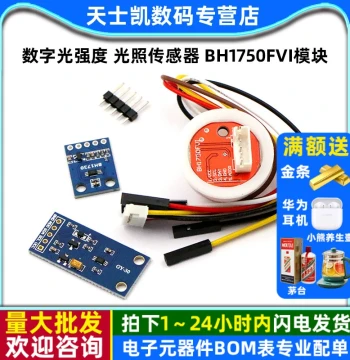
| Sensor Type | TSL2561 Light-to-Digital |
| Interface | I2C (Inter-Integrated Circuit) |
| Operating Voltage | 3.3V - 5V DC |
| Dynamic Range | 1 to 40,000 Lux |
| Spectral Response | Approximates Human Eye |
| Integration Time | Programmable (13ms, 101ms, 402ms) |
| Gain Settings | 1x, 16x, Auto-Gain |
| Package Type | GY-2561 Breakout Board |
| Dimensions | 14mm x 19mm x 3mm |
| Application | Arduino, Raspberry Pi, IoT Projects |
Anonymous
Mar 29, 2026
Rating: 5/5
Great for school robotics
Used this for a line-following robot that needs to adapt to ambient light. It responded very quickly to changes. The documentation online made coding it a breeze.
Anonymous
Mar 26, 2026
Rating: 5/5
Excellent sensitivity range
The dynamic range is impressive. It handles both dim indoor lighting and bright outdoor sun without saturating immediately thanks to the auto-gain feature. A must-have sensor.
Anonymous
Mar 19, 2026
Rating: 4/5
Good value, easy to integrate
The module arrived quickly and was easy to solder. The library support for ESP32 is excellent. Only giving 4 stars because the pin headers were not included, but that's a minor issue.
Anonymous
Mar 11, 2026
Rating: 4/5
Reliable for plant monitoring
Running this in my automated greenhouse to monitor sunlight exposure. It has been running for three months without issues. Wish it had a waterproof coating, but otherwise solid.
Anonymous
Mar 09, 2026
Rating: 5/5
Perfect for my smart home project
This sensor works flawlessly with my Arduino setup. The I2C communication is stable, and the readings are consistent even in varying light conditions. Highly recommended for beginners.
Anonymous
Mar 01, 2026
Rating: 5/5
Accurate lux measurements
I compared this against a professional lux meter, and the TSL2561 is surprisingly accurate within its specified range. The ability to adjust gain and integration time is a huge plus.
Q: What is the maximum distance for I2C communication with this sensor?
A: Standard I2C protocols recommend keeping cable lengths under 30cm for reliability. For longer distances, you may need an I2C extender or buffer.
Q: Is there a sample code available for Raspberry Pi?
A: Absolutely. We provide Python libraries and example scripts on our GitHub repository specifically tailored for Raspberry Pi GPIO usage.
Q: Is this module compatible with 5V Arduino Uno?
A: Yes, the GY-2561 module typically includes a voltage regulator and level shifters, making it safe to use with 5V logic boards like the Arduino Uno.
Q: Can I connect multiple of these sensors to one microcontroller?
A: Yes, provided you can manage different I2C addresses. Some breakout boards allow you to change the address via a solder jumper; otherwise, you may need an I2C multiplexer.
Q: Does this sensor detect UV or IR light specifically?
A: The TSL2561 is designed to approximate the human eye's response to visible light. It filters out most UV and IR to provide accurate lux readings for human-centric applications.