Anonymous
Mar 28, 2026
Rating: 5/5
Reliable for prototyping
We use these for initial control loop prototyping before moving to custom PCBs. The stability is comparable to more expensive boards, and the price point allows us to keep several on hand.
Description
Reviews
| Brand | - |
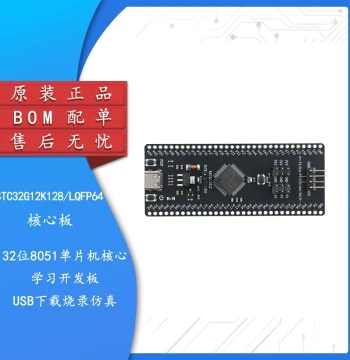
| Category | Robotics / STEM Teaching Tools / Development, Learning, Evaluation & Industrial Control Boards |
| Origin | - |
| Microcontroller | CH32V103C8T6 (RISC-V 32-bit) |
| Core Architecture | QingKe V3 Core, up to 72MHz |
| Flash Memory | 64 KB |
| SRAM | 20 KB |
| Interface Type | USB Type-C for Power and Debugging |
| GPIO Pins | Multiple 5V tolerant I/O ports |
| Peripherals | ADC, DAC, USART, SPI, I2C, Timers |
| Compatibility | Pin-compatible with STM32F103C8T6 |
| Debug Protocol | Supports WCH-LinkE and J-Link |
| Board Dimensions | Approx. 53mm x 23mm |
Anonymous
Mar 28, 2026
Rating: 5/5
Reliable for prototyping
We use these for initial control loop prototyping before moving to custom PCBs. The stability is comparable to more expensive boards, and the price point allows us to keep several on hand.
Anonymous
Mar 22, 2026
Rating: 4/5
Great value, minor documentation gaps
Hardware quality is solid and the pinout matches the standard Blue Pill layout perfectly. Had to dig a bit for specific register maps compared to STM32, but community support is growing fast.
Anonymous
Mar 19, 2026
Rating: 5/5
Excellent RISC-V alternative
This board works flawlessly as a drop-in replacement for my old STM32 projects. The Type-C interface is a huge plus for modern setups. Compilation speed with the MounRiver IDE is impressive.
Anonymous
Mar 09, 2026
Rating: 5/5
Perfect for learning RISC-V
Bought this to learn about non-ARM architectures. The setup was straightforward, and the performance at 72MHz handles my sensor logging project without breaking a sweat.
Anonymous
Mar 03, 2026
Rating: 4/5
Good hardware, needs specific debugger
The board itself is fantastic. Just remember you need a WCH-Link or compatible debugger; standard ST-Link v2 doesn't work out of the box without firmware modifications. Once set up, it's smooth sailing.
Anonymous
Mar 03, 2026
Rating: 5/5
Best budget dev board
As a student, the low cost allowed me to buy three for different projects. The Type-C port is durable, and the onboard LED helps with quick debugging tests. Highly recommended.
Q: Is this board compatible with the Arduino IDE?
A: Yes, it can be used with the Arduino IDE by installing the appropriate CH32V package via the Board Manager or manually adding the core files. Many examples are available online.
Q: Does the Type-C port support data transfer or just power?
A: On this specific development board, the Type-C connector is primarily used for power supply and SWD debugging programming. It does not typically expose a full USB Device/Host controller for data communication unless specifically routed in your code and hardware design.
Q: Can I use an ST-Link V2 programmer with this board?
A: Standard ST-Link V2 debuggers do not natively support the CH32V series. We recommend using the WCH-LinkE debugger or a J-Link probe which has added support for RISC-V chips.
Q: Where can I find the schematic for this board?
A: The open-source schematic and PCB files are usually available on the manufacturer's GitHub repository or the product page under the 'Downloads' section. This allows for easy customization and understanding of the circuit.
Q: What is the operating voltage range for the GPIO pins?
A: The CH32V103C8T6 operates at 3.3V logic levels. Most GPIO pins are 5V tolerant when configured in specific modes, but always refer to the datasheet for exact electrical characteristics before connecting 5V sensors.