Anonymous
Apr 16, 2026
Rating: 5/5
ESP-IDF Ready
Compiled my first project instantly. The USB download speed is much faster than previous generations.
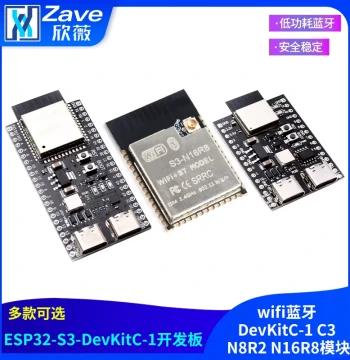
Description
Reviews
| Brand | - |
| Category | Electronic Components / Maker DIY / Development Boards & Control Boards |
| Origin | - |
| Chip Model | ESP32-S3-WROOM-1 |
| Flash Memory | 8MB or 16MB Options |
| PSRAM | 2MB or 8MB Options |
| WiFi Standard | 802.11 b/g/n 2.4GHz |
| Bluetooth Version | Bluetooth 5 (LE) |
| GPIO Pins | 45 Programmable GPIOs |
| Input Voltage | 5V DC via USB |
| Logic Level | 3.3V |
| USB Interface | USB OTG & UART Download |
| Board Dimensions | 54.9mm x 28.5mm |
Anonymous
Apr 16, 2026
Rating: 5/5
ESP-IDF Ready
Compiled my first project instantly. The USB download speed is much faster than previous generations.
Anonymous
Mar 15, 2026
Rating: 4/5
Good value
Works well for most projects. The pin headers are a bit tight for some breadboards, but otherwise solid hardware.
Anonymous
Mar 05, 2026
Rating: 5/5
Perfect for Prototyping
Great board for IoT prototypes. USB-C charging is convenient. Would recommend for anyone starting with ESP32.
Anonymous
Feb 18, 2026
Rating: 5/5
Reliable Connectivity
WiFi range is impressive compared to older ESP8266 boards. Bluetooth LE pairing works smoothly with my phone app.
Anonymous
Jan 28, 2026
Rating: 5/5
Excellent for Edge AI
The vector instructions on the S3 make a noticeable difference in my ML projects. Setup was straightforward using ESP-IDF.
Q: Does this support camera modules?
A: Yes, the ESP32-S3 supports a DVP camera interface. It is compatible with many OV2640 and OV5640 camera modules.
Q: Is this board supported by the Arduino IDE?
A: Yes, this board is fully supported by the Arduino IDE. You need to add the ESP32 board manager URL to install the necessary cores.
Q: What is the difference between N8R2 and N16R8?
A: N refers to Flash memory size (8MB vs 16MB) and R refers to PSRAM size (2MB vs 8MB). Choose based on your storage and memory requirements.
Q: Is JTAG debugging available on this board?
A: Yes, JTAG debugging is supported via the USB interface. You can use OpenOCD for debugging your applications.
Q: What is the maximum current per GPIO pin?
A: Each GPIO pin can source or sink up to 40mA. The total current across all GPIOs should not exceed the specified limits in the datasheet.