Anonymous
Apr 08, 2026
Rating: 5/5
Fast and Precise
Great for obstacle avoidance. The measurement frequency is high enough for my drone project. Very happy with the performance.
Description
Reviews
| Brand | - |
| Category | Electronic Components / Maker DIY / Computer Hardware, Monitors & Peripherals |
| Origin | - |
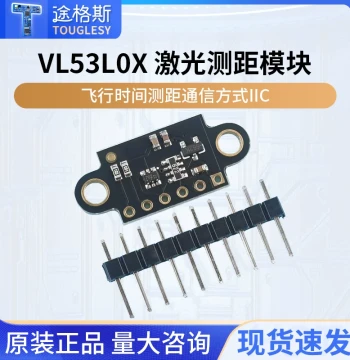
| Sensing Range | Up to 2 meters |
| Interface | I2C |
| Operating Voltage | 2.6V to 3.5V |
| Accuracy | +/- 3% of distance |
| Measurement Frequency | Up to 50 Hz |
| Field of View | 25 degrees typical |
| Module Dimensions | 25mm x 15mm x 5mm |
| Weight | 2 grams |
| Microcontroller Compatibility | Arduino, Raspberry Pi, ESP32 |
| Package Content | Sensor Module, Header Pins |
Anonymous
Apr 08, 2026
Rating: 5/5
Fast and Precise
Great for obstacle avoidance. The measurement frequency is high enough for my drone project. Very happy with the performance.
Anonymous
Feb 22, 2026
Rating: 3/5
Needs level shifter
Works well but remember it's 3.3V logic. If you connect directly to 5V Arduino without a level shifter, you might risk damage. Instructions could be clearer.
Anonymous
Feb 20, 2026
Rating: 4/5
Good but sensitive to light
Accurate indoors, struggles in direct sunlight as expected for ToF sensors. Otherwise, the build quality is solid and wiring was straightforward.
Anonymous
Feb 10, 2026
Rating: 5/5
Perfect for Robotics
Works flawlessly with my Arduino Uno. The library support is excellent and the readings are stable indoors. Great for obstacle avoidance projects.
Anonymous
Jan 26, 2026
Rating: 5/5
Excellent Value
Cheaper than competitors with the same performance. I bought five for a multi-sensor array and they all work consistently.
Q: Is this suitable for outdoor use?
A: It is not recommended for use in direct sunlight as ambient light can interfere with the infrared laser measurements.
Q: What is the maximum reliable range?
A: The sensor is optimized for ranges up to 2 meters. Beyond this, accuracy may decrease depending on target reflectivity.
Q: Is this module 5V tolerant?
A: No, the operating voltage is 2.6V to 3.5V. Please use a logic level shifter when connecting to 5V microcontrollers.
Q: Are there libraries available for Arduino?
A: Yes, there are several open-source libraries available, including those from Pololu and Adafruit, to simplify integration.
Q: Can I use multiple sensors on one I2C bus?
A: Yes, multiple sensors can be used by controlling the XSHUT pin to disable them individually during address configuration.