Anonymous
Apr 03, 2026
Rating: 4/5
Good value, minor soldering needed
Module works well but headers weren't included. Had to solder my own pins. Otherwise functional and meets specs.
Description
Reviews
| Brand | - |
| Category | Electronic Components / Maker DIY / Computer Hardware, Monitors & Peripherals |
| Origin | - |
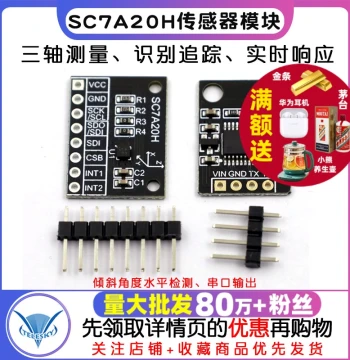
| Chip Model | MMA8452Q |
| Communication Interface | I2C (Inter-Integrated Circuit) |
| Operating Voltage | 3.3V - 5V DC |
| Measurement Range | ±2g / ±4g / ±8g selectable |
| Output Resolution | 14-bit |
| Operating Current | 6μA - 165μA (depending on mode) |
| Operating Temperature | -40°C to +85°C |
| PCB Dimensions | 16mm x 24mm (approx) |
| Module Weight | 3 grams |
| Microcontroller Compatibility | Arduino, Raspberry Pi, STM32, ESP32 |
Anonymous
Apr 03, 2026
Rating: 4/5
Good value, minor soldering needed
Module works well but headers weren't included. Had to solder my own pins. Otherwise functional and meets specs.
Anonymous
Mar 28, 2026
Rating: 5/5
Reliable data output
Noise levels are low. The selectable range is useful for different sensitivity needs. Recommended for embedded systems.
Anonymous
Mar 24, 2026
Rating: 5/5
Great for tilt projects
Works perfectly with my Arduino Uno. Library examples were easy to upload. Accurate angle readings for my stabilizer project.
Anonymous
Mar 13, 2026
Rating: 5/5
Perfect for school project
Arrived quickly. Documentation online is plentiful. Got my grade thanks to this sensor working flawlessly.
Anonymous
Jan 27, 2026
Rating: 5/5
Solid sensor for robotics
Using this for balance robot project. Low power consumption is a plus. Stable I2C connection even during movement.
Q: Are libraries available for Python?
A: Yes, CircuitPython and standard Python libraries are available for Raspberry Pi.
Q: Is this module 5V tolerant?
A: Yes, the module includes a voltage regulator, safe for 5V logic systems.
Q: What is the default I2C address?
A: The default address is 0x1D. It can be changed to 0x1C via the SA0 pin.
Q: How accurate is the angle measurement?
A: Accuracy depends on calibration, but typically within 1-2 degrees for static tilt.
Q: Does it work with ESP32?
A: Yes, it is compatible with ESP32 via I2C pins GPIO 21 and 22.