Anonymous
Apr 05, 2026
Rating: 5/5
Industry standard chip
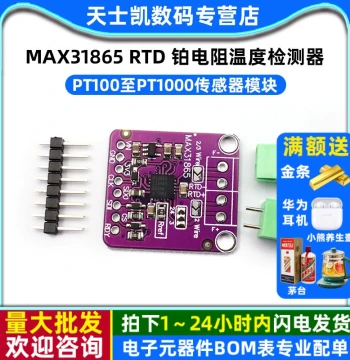
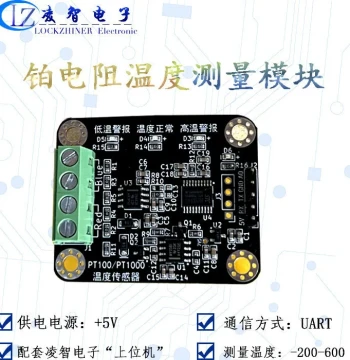
Using the MAX31865 chip ensures reliability. Great for industrial temp monitoring where precision matters.
Description
Reviews
| Brand | - |
| Category | Electronic Components / Maker DIY / Computer Hardware, Monitors & Peripherals |
| Origin | - |
| Interface Protocol | SPI (4-wire) |
| Supply Voltage | 3.0V to 3.6V |
| Sensor Support | PT100 and PT1000 |
| Wire Configuration | 2, 3, or 4-wire |
| Data Resolution | 15-bit |
| Accuracy | ±0.1% typical |
| Module Operating Temperature | -20°C to +85°C |
| PCB Length | 25mm |
| PCB Width | 17mm |
| Net Weight | 3.5g |
Anonymous
Apr 05, 2026
Rating: 5/5
Industry standard chip
Using the MAX31865 chip ensures reliability. Great for industrial temp monitoring where precision matters.
Anonymous
Mar 22, 2026
Rating: 4/5
Good module, tricky wiring
The module itself is great but setting up the 3-wire configuration took some reading. Once done, very stable.
Anonymous
Mar 21, 2026
Rating: 5/5
Fast delivery
Arrived quickly and well packaged. Tested immediately with PT100 sensor and it worked out of the box.
Anonymous
Feb 01, 2026
Rating: 5/5
Perfect for my kiln project
Works flawlessly with my Raspberry Pi. Accuracy is spot on compared to my thermocouple. Very stable readings over long periods.
Anonymous
Jan 18, 2026
Rating: 3/5
Works but needs library
Had to search for a compatible Arduino library. Hardware is fine though, just wish documentation was clearer.
Q: Can it measure below zero?
A: Yes, it supports temperature ranges well below freezing depending on the specific sensor used.
Q: Is the logic level 5V tolerant?
A: The module operates at 3.3V. Please use a logic level converter for 5V microcontrollers to avoid damage.
Q: Does this support PT1000 sensors?
A: Yes, this module supports both PT100 and PT1000 sensors via jumper selection on the board.
Q: Is the sensor included in the package?
A: No, this is only the breakout board. Sensors are sold separately to allow for custom probe lengths.
Q: What is the sampling rate?
A: The conversion time is typically around 60ms per sample, allowing for roughly 16 readings per second.